mirror of
https://github.com/stefanprodan/podinfo.git
synced 2026-04-09 12:36:50 +00:00

196 lines
7.2 KiB
Markdown
196 lines
7.2 KiB
Markdown
# podinfo
|
||
|
||
[](https://github.com/stefanprodan/podinfo/blob/master/.github/workflows/e2e.yml)
|
||
[](https://github.com/stefanprodan/podinfo/blob/master/.github/workflows/test.yml)
|
||
[](https://github.com/stefanprodan/podinfo/blob/master/.github/workflows/cve-scan.yml)
|
||
[](https://goreportcard.com/report/github.com/stefanprodan/podinfo)
|
||
[](https://hub.docker.com/r/stefanprodan/podinfo)
|
||
|
||
Podinfo is a tiny web application made with Go that showcases best practices of running microservices in Kubernetes.
|
||
Podinfo is used by CNCF projects like [Flux](https://github.com/fluxcd/flux2) and [Flagger](https://github.com/fluxcd/flagger)
|
||
for end-to-end testing and workshops.
|
||
|
||
Specifications:
|
||
|
||
* Health checks (readiness and liveness)
|
||
* Graceful shutdown on interrupt signals
|
||
* File watcher for secrets and configmaps
|
||
* Instrumented with Prometheus and Open Telemetry
|
||
* Structured logging with zap
|
||
* 12-factor app with viper
|
||
* Fault injection (random errors and latency)
|
||
* Swagger docs
|
||
* CUE, Helm and Kustomize installers
|
||
* End-to-End testing with Kubernetes Kind and Helm
|
||
* Kustomize testing with GitHub Actions and Open Policy Agent
|
||
* Multi-arch container image with Docker buildx and Github Actions
|
||
* Container image signing with Sigstore cosign
|
||
* CVE scanning with Trivy
|
||
|
||
Web API:
|
||
|
||
* `GET /` prints runtime information
|
||
* `GET /version` prints podinfo version and git commit hash
|
||
* `GET /metrics` return HTTP requests duration and Go runtime metrics
|
||
* `GET /healthz` used by Kubernetes liveness probe
|
||
* `GET /readyz` used by Kubernetes readiness probe
|
||
* `POST /readyz/enable` signals the Kubernetes LB that this instance is ready to receive traffic
|
||
* `POST /readyz/disable` signals the Kubernetes LB to stop sending requests to this instance
|
||
* `GET /status/{code}` returns the status code
|
||
* `GET /panic` crashes the process with exit code 255
|
||
* `POST /echo` forwards the call to the backend service and echos the posted content
|
||
* `GET /env` returns the environment variables as a JSON array
|
||
* `GET /headers` returns a JSON with the request HTTP headers
|
||
* `GET /delay/{seconds}` waits for the specified period
|
||
* `POST /token` issues a JWT token valid for one minute `JWT=$(curl -sd 'anon' podinfo:9898/token | jq -r .token)`
|
||
* `GET /token/validate` validates the JWT token `curl -H "Authorization: Bearer $JWT" podinfo:9898/token/validate`
|
||
* `GET /configs` returns a JSON with configmaps and/or secrets mounted in the `config` volume
|
||
* `POST/PUT /cache/{key}` saves the posted content to Redis
|
||
* `GET /cache/{key}` returns the content from Redis if the key exists
|
||
* `DELETE /cache/{key}` deletes the key from Redis if exists
|
||
* `POST /store` writes the posted content to disk at /data/hash and returns the SHA1 hash of the content
|
||
* `GET /store/{hash}` returns the content of the file /data/hash if exists
|
||
* `GET /ws/echo` echos content via websockets `podcli ws ws://localhost:9898/ws/echo`
|
||
* `GET /chunked/{seconds}` uses `transfer-encoding` type `chunked` to give a partial response and then waits for the specified period
|
||
* `GET /swagger.json` returns the API Swagger docs, used for Linkerd service profiling and Gloo routes discovery
|
||
|
||
gRPC API:
|
||
|
||
* `/grpc.health.v1.Health/Check` health checking
|
||
|
||
Web UI:
|
||
|
||
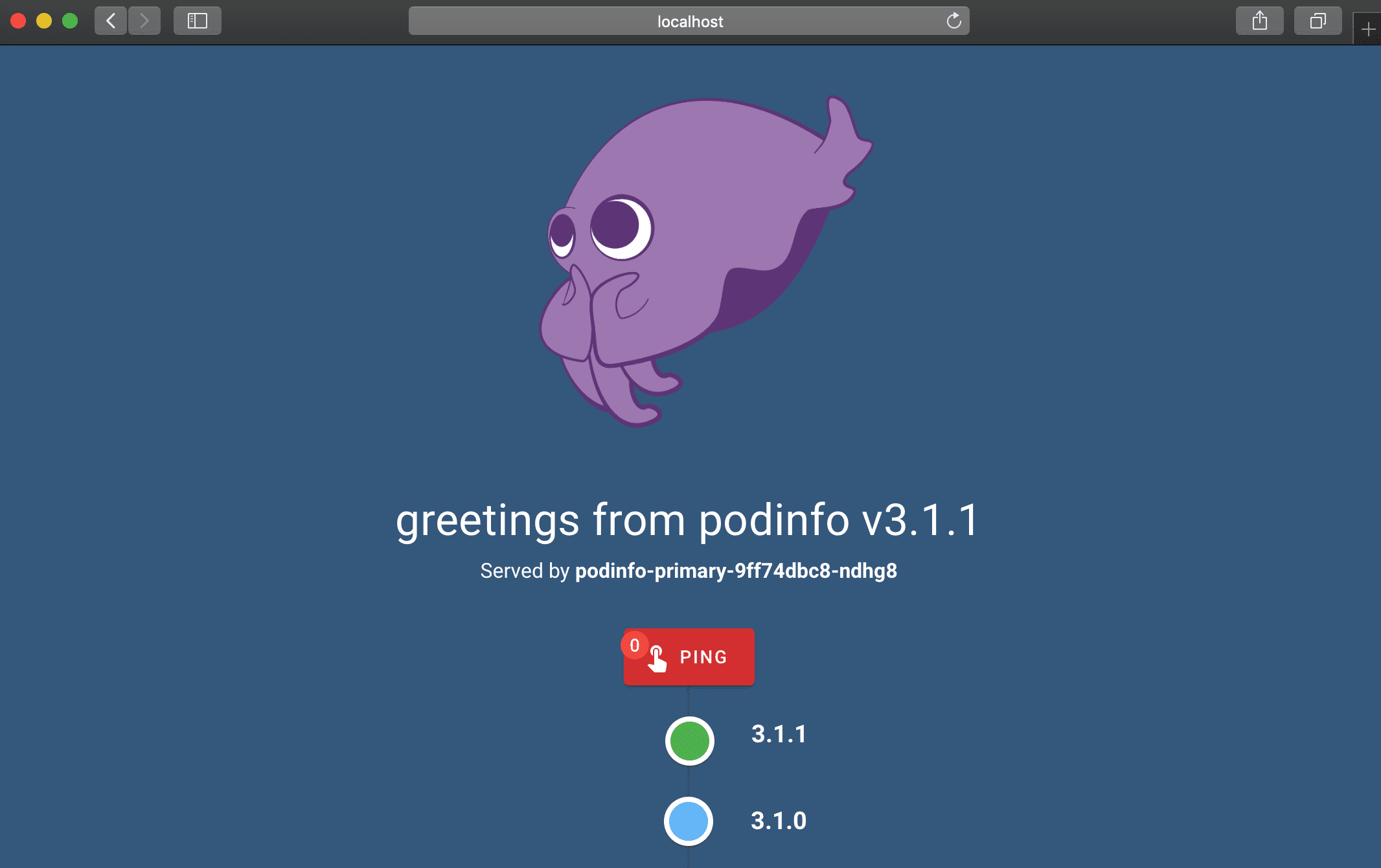
|
||
|
||
To access the Swagger UI open `<podinfo-host>/swagger/index.html` in a browser.
|
||
|
||
### Guides
|
||
|
||
* [GitOps Progressive Deliver with Flagger, Helm v3 and Linkerd](https://helm.workshop.flagger.dev/intro/)
|
||
* [GitOps Progressive Deliver on EKS with Flagger and AppMesh](https://eks.handson.flagger.dev/prerequisites/)
|
||
* [Automated canary deployments with Flagger and Istio](https://medium.com/google-cloud/automated-canary-deployments-with-flagger-and-istio-ac747827f9d1)
|
||
* [Kubernetes autoscaling with Istio metrics](https://medium.com/google-cloud/kubernetes-autoscaling-with-istio-metrics-76442253a45a)
|
||
* [Autoscaling EKS on Fargate with custom metrics](https://aws.amazon.com/blogs/containers/autoscaling-eks-on-fargate-with-custom-metrics/)
|
||
* [Managing Helm releases the GitOps way](https://medium.com/google-cloud/managing-helm-releases-the-gitops-way-207a6ac6ff0e)
|
||
* [Securing EKS Ingress With Contour And Let’s Encrypt The GitOps Way](https://aws.amazon.com/blogs/containers/securing-eks-ingress-contour-lets-encrypt-gitops/)
|
||
|
||
### Install
|
||
|
||
#### Helm
|
||
|
||
Install from github.io:
|
||
|
||
```bash
|
||
helm repo add podinfo https://stefanprodan.github.io/podinfo
|
||
|
||
helm upgrade --install --wait frontend \
|
||
--namespace test \
|
||
--set replicaCount=2 \
|
||
--set backend=http://backend-podinfo:9898/echo \
|
||
podinfo/podinfo
|
||
|
||
helm test frontend --namespace test
|
||
|
||
helm upgrade --install --wait backend \
|
||
--namespace test \
|
||
--set redis.enabled=true \
|
||
podinfo/podinfo
|
||
```
|
||
|
||
Install from ghcr.io:
|
||
|
||
```bash
|
||
helm upgrade --install --wait podinfo --namespace default \
|
||
oci://ghcr.io/stefanprodan/charts/podinfo
|
||
```
|
||
|
||
#### Kustomize
|
||
|
||
```bash
|
||
kubectl apply -k github.com/stefanprodan/podinfo//kustomize
|
||
```
|
||
|
||
#### Docker
|
||
|
||
```bash
|
||
docker run -dp 9898:9898 stefanprodan/podinfo
|
||
```
|
||
|
||
### Continuous Delivery
|
||
|
||
In order to install podinfo on a Kubernetes cluster and keep it up to date with the latest
|
||
release in an automated manner, you can use [Flux](https://fluxcd.io).
|
||
|
||
Install the Flux CLI on MacOS and Linux using Homebrew:
|
||
|
||
```sh
|
||
brew install fluxcd/tap/flux
|
||
```
|
||
|
||
Install the Flux controllers needed for Helm operations:
|
||
|
||
```sh
|
||
flux install \
|
||
--namespace=flux-system \
|
||
--network-policy=false \
|
||
--components=source-controller,helm-controller
|
||
```
|
||
|
||
Add podinfo's Helm repository to your cluster and
|
||
configure Flux to check for new chart releases every ten minutes:
|
||
|
||
```sh
|
||
flux create source helm podinfo \
|
||
--namespace=default \
|
||
--url=https://stefanprodan.github.io/podinfo \
|
||
--interval=10m
|
||
```
|
||
|
||
Create a `podinfo-values.yaml` file locally:
|
||
|
||
```sh
|
||
cat > podinfo-values.yaml <<EOL
|
||
replicaCount: 2
|
||
resources:
|
||
limits:
|
||
memory: 256Mi
|
||
requests:
|
||
cpu: 100m
|
||
memory: 64Mi
|
||
EOL
|
||
```
|
||
|
||
Create a Helm release for deploying podinfo in the default namespace:
|
||
|
||
```sh
|
||
flux create helmrelease podinfo \
|
||
--namespace=default \
|
||
--source=HelmRepository/podinfo \
|
||
--release-name=podinfo \
|
||
--chart=podinfo \
|
||
--chart-version=">5.0.0" \
|
||
--values=podinfo-values.yaml
|
||
```
|
||
|
||
Based on the above definition, Flux will upgrade the release automatically
|
||
when a new version of podinfo is released. If the upgrade fails, Flux
|
||
can [rollback](https://toolkit.fluxcd.io/components/helm/helmreleases/#configuring-failure-remediation)
|
||
to the previous working version.
|
||
|
||
You can check what version is currently deployed with:
|
||
|
||
```sh
|
||
flux get helmreleases -n default
|
||
```
|
||
|
||
To delete podinfo's Helm repository and release from your cluster run:
|
||
|
||
```sh
|
||
flux -n default delete source helm podinfo
|
||
flux -n default delete helmrelease podinfo
|
||
```
|
||
|
||
If you wish to manage the lifecycle of your applications in a **GitOps** manner, check out
|
||
this [workflow example](https://github.com/fluxcd/flux2-kustomize-helm-example)
|
||
for multi-env deployments with Flux, Kustomize and Helm.
|