mirror of
https://github.com/fluxcd/flagger.git
synced 2026-03-02 17:51:00 +00:00
 8c55bb222d
Fixes #606.

Also fixed the alert message to keep it consistent with the message,
along with the documentation.
359 lines
10 KiB
Markdown
359 lines
10 KiB
Markdown
# Crossover Canary Deployments
|
||
|
||
This guide shows you how to use Envoy, [Crossover](https://github.com/mumoshu/crossover) and Flagger to automate canary deployments.
|
||
|
||
Crossover is a minimal Envoy xDS implementation supports [Service Mesh Interface](https://smi-spec.io/).
|
||
|
||
## Prerequisites
|
||
|
||
Flagger requires a Kubernetes cluster **v1.11** or newer and Envoy paired with [Crossover](https://github.com/mumoshu/crossover) sidecar.
|
||
|
||
Create a test namespace:
|
||
|
||
```bash
|
||
kubectl create ns test
|
||
```
|
||
|
||
Install Envoy along with the Crossover sidecar with Helm:
|
||
|
||
```bash
|
||
helm repo add crossover https://mumoshu.github.io/crossover
|
||
|
||
helm upgrade --install envoy crossover/envoy \
|
||
--namespace test \
|
||
-f <(cat <<EOF
|
||
smi:
|
||
apiVersions:
|
||
trafficSplits: v1alpha1
|
||
upstreams:
|
||
podinfo:
|
||
smi:
|
||
enabled: true
|
||
backends:
|
||
podinfo-primary:
|
||
port: 9898
|
||
weight: 100
|
||
podinfo-canary:
|
||
port: 9898
|
||
weight: 0
|
||
EOF
|
||
)
|
||
```
|
||
|
||
Install Flagger and the Prometheus add-on in the same namespace as Envoy:
|
||
|
||
```bash
|
||
helm repo add flagger https://flagger.app
|
||
|
||
helm upgrade -i flagger flagger/flagger \
|
||
--namespace test \
|
||
--set prometheus.install=true \
|
||
--set meshProvider=smi:crossover
|
||
```
|
||
|
||
## Bootstrap
|
||
|
||
Flagger takes a Kubernetes deployment and optionally a horizontal pod autoscaler (HPA),
|
||
then creates a series of objects (Kubernetes deployments, ClusterIP services, SMI traffic splits).
|
||
These objects expose the application on the mesh and drive the canary analysis and promotion.
|
||
There's no SMI object you need to create by yourself.
|
||
|
||
Create a deployment and a horizontal pod autoscaler:
|
||
|
||
```bash
|
||
kubectl apply -k github.com/weaveworks/flagger//kustomize/podinfo
|
||
```
|
||
|
||
Deploy the load testing service to generate traffic during the canary analysis:
|
||
|
||
```bash
|
||
helm upgrade -i flagger-loadtester flagger/loadtester \
|
||
--namespace=test
|
||
```
|
||
|
||
Create a metric template to measure the HTTP requests error rate:
|
||
|
||
```yaml
|
||
apiVersion: flagger.app/v1beta1
|
||
kind: MetricTemplate
|
||
metadata:
|
||
name: error-rate
|
||
namespace: test
|
||
spec:
|
||
provider:
|
||
address: http://flagger-prometheus:9090
|
||
type: prometheus
|
||
query: |
|
||
100 - rate(
|
||
envoy_cluster_upstream_rq{
|
||
kubernetes_namespace="{{ namespace }}",
|
||
envoy_cluster_name="{{ target }}-canary",
|
||
envoy_response_code!~"5.*"
|
||
}[{{ interval }}])
|
||
/
|
||
rate(
|
||
envoy_cluster_upstream_rq{
|
||
kubernetes_namespace="{{ namespace }}",
|
||
envoy_cluster_name="{{ target }}-canary"
|
||
}[{{ interval }}]
|
||
) * 100
|
||
```
|
||
|
||
Create a metric template to measure the HTTP requests average duration:
|
||
|
||
```yaml
|
||
apiVersion: flagger.app/v1beta1
|
||
kind: MetricTemplate
|
||
metadata:
|
||
name: latency
|
||
namespace: test
|
||
spec:
|
||
provider:
|
||
address: http://flagger-prometheus:9090
|
||
type: prometheus
|
||
query: |
|
||
histogram_quantile(0.99,
|
||
sum(
|
||
rate(
|
||
envoy_cluster_upstream_rq_time_bucket{
|
||
kubernetes_namespace="{{ namespace }}",
|
||
envoy_cluster_name="{{ target }}-canary"
|
||
}[{{ interval }}]
|
||
)
|
||
) by (le)
|
||
)
|
||
```
|
||
|
||
Create a canary custom resource:
|
||
|
||
```yaml
|
||
apiVersion: flagger.app/v1beta1
|
||
kind: Canary
|
||
metadata:
|
||
name: podinfo
|
||
namespace: test
|
||
spec:
|
||
provider: "smi:crossover"
|
||
# deployment reference
|
||
targetRef:
|
||
apiVersion: apps/v1
|
||
kind: Deployment
|
||
name: podinfo
|
||
progressDeadlineSeconds: 60
|
||
# HPA reference (optional)
|
||
autoscalerRef:
|
||
apiVersion: autoscaling/v2beta1
|
||
kind: HorizontalPodAutoscaler
|
||
name: podinfo
|
||
service:
|
||
port: 9898
|
||
# define the canary analysis timing and KPIs
|
||
analysis:
|
||
# schedule interval (default 60s)
|
||
interval: 1m
|
||
# max number of failed metric checks before rollback
|
||
threshold: 5
|
||
# max traffic percentage routed to canary
|
||
# percentage (0-100)
|
||
maxWeight: 50
|
||
# canary increment step
|
||
# percentage (0-100)
|
||
stepWeight: 5
|
||
metrics:
|
||
- name: error-rate
|
||
templateRef:
|
||
name: error-rate
|
||
thresholdRange:
|
||
max: 1
|
||
interval: 30s
|
||
- name: latency
|
||
templateRef:
|
||
name: latency
|
||
thresholdRange:
|
||
max: 0.5
|
||
interval: 30s
|
||
webhooks:
|
||
- name: acceptance-test
|
||
type: pre-rollout
|
||
url: http://flagger-loadtester.test/
|
||
timeout: 30s
|
||
metadata:
|
||
type: bash
|
||
cmd: "curl -sd 'test' http://podinfo-canary.test:9898/token | grep token"
|
||
- name: load-test
|
||
url: http://flagger-loadtester.test/
|
||
timeout: 5s
|
||
metadata:
|
||
cmd: "hey -z 1m -q 10 -c 2 -H 'Host: podinfo.test' http://envoy.test:10000/"
|
||
```
|
||
|
||
Save the above resource as podinfo-canary.yaml and then apply it:
|
||
|
||
```bash
|
||
kubectl apply -f ./podinfo-canary.yaml
|
||
```
|
||
|
||
After a couple of seconds Flagger will create the canary objects:
|
||
|
||
```bash
|
||
# applied
|
||
deployment.apps/podinfo
|
||
horizontalpodautoscaler.autoscaling/podinfo
|
||
canary.flagger.app/podinfo
|
||
|
||
# generated
|
||
deployment.apps/podinfo-primary
|
||
horizontalpodautoscaler.autoscaling/podinfo-primary
|
||
service/podinfo
|
||
service/podinfo-canary
|
||
service/podinfo-primary
|
||
trafficsplits.split.smi-spec.io/podinfo
|
||
```
|
||
|
||
After the boostrap, the podinfo deployment will be scaled to zero and the traffic to `podinfo.test`
|
||
will be routed to the primary pods. During the canary analysis,
|
||
the `podinfo-canary.test` address can be used to target directly the canary pods.
|
||
|
||
## Automated canary promotion
|
||
|
||
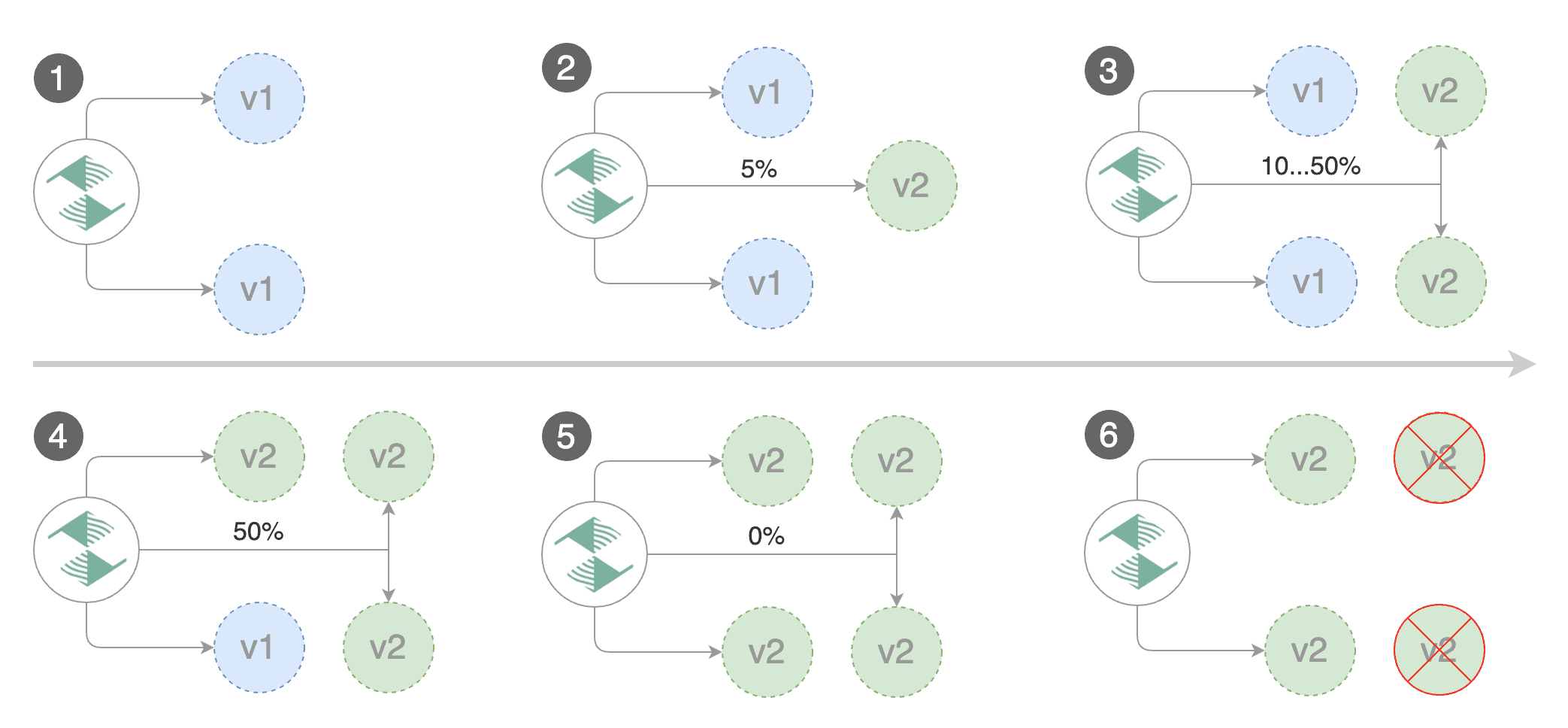
Flagger implements a control loop that gradually shifts traffic to the canary while measuring
|
||
key performance indicators like HTTP requests success rate, requests average duration and pod health.
|
||
Based on analysis of the KPIs a canary is promoted or aborted, and the analysis result is published to Slack.
|
||
|
||
|
||
|
||
A canary deployment is triggered by changes in any of the following objects:
|
||
|
||
* Deployment PodSpec (container image, command, ports, env, resources, etc)
|
||
* ConfigMaps and Secrets mounted as volumes or mapped to environment variables
|
||
|
||
Trigger a canary deployment by updating the container image:
|
||
|
||
```bash
|
||
kubectl -n test set image deployment/podinfo \
|
||
podinfod=stefanprodan/podinfo:3.1.5
|
||
```
|
||
|
||
Flagger detects that the deployment revision changed and starts a new rollout:
|
||
|
||
```text
|
||
kubectl -n test describe canary/podinfo
|
||
|
||
Status:
|
||
Canary Weight: 0
|
||
Failed Checks: 0
|
||
Phase: Succeeded
|
||
Events:
|
||
New revision detected! Scaling up podinfo.test
|
||
Waiting for podinfo.test rollout to finish: 0 of 1 updated replicas are available
|
||
Pre-rollout check acceptance-test passed
|
||
Advance podinfo.test canary weight 5
|
||
Advance podinfo.test canary weight 10
|
||
Advance podinfo.test canary weight 15
|
||
Advance podinfo.test canary weight 20
|
||
Advance podinfo.test canary weight 25
|
||
Advance podinfo.test canary weight 30
|
||
Advance podinfo.test canary weight 35
|
||
Advance podinfo.test canary weight 40
|
||
Advance podinfo.test canary weight 45
|
||
Advance podinfo.test canary weight 50
|
||
Copying podinfo.test template spec to podinfo-primary.test
|
||
Waiting for podinfo-primary.test rollout to finish: 1 of 2 updated replicas are available
|
||
Routing all traffic to primary
|
||
Promotion completed! Scaling down podinfo.test
|
||
```
|
||
|
||
When the canary analysis starts, Flagger will call the pre-rollout webhooks before routing traffic to the canary.
|
||
|
||
**Note** that if you apply new changes to the deployment during the canary analysis, Flagger will restart the analysis.
|
||
|
||
During the analysis the canary’s progress can be monitored with Grafana.
|
||
|
||
Flagger comes with a Grafana dashboard made for canary analysis. Install Grafana with Helm:
|
||
|
||
```bash
|
||
helm upgrade -i flagger-grafana flagger/grafana \
|
||
--namespace=test \
|
||
--set url=http://flagger-prometheus:9090
|
||
```
|
||
|
||
Run:
|
||
|
||
```bash
|
||
kubectl port-forward --namespace test svc/flagger-grafana 3000:80
|
||
```
|
||
|
||
The Envoy dashboard URL is [http://localhost:3000/d/flagger-envoy/envoy-canary?refresh=10s&orgId=1&var-namespace=test&var-target=podinfo](http://localhost:3000/d/flagger-envoy/envoy-canary?refresh=10s&orgId=1&var-namespace=test&var-target=podinfo)
|
||
|
||

|
||
|
||
You can monitor all canaries with:
|
||
|
||
```bash
|
||
watch kubectl get canaries --all-namespaces
|
||
|
||
NAMESPACE NAME STATUS WEIGHT LASTTRANSITIONTIME
|
||
test podinfo Progressing 15 2019-10-02T14:05:07Z
|
||
prod frontend Succeeded 0 2019-10-02T16:15:07Z
|
||
prod backend Failed 0 2019-10-02T17:05:07Z
|
||
```
|
||
|
||
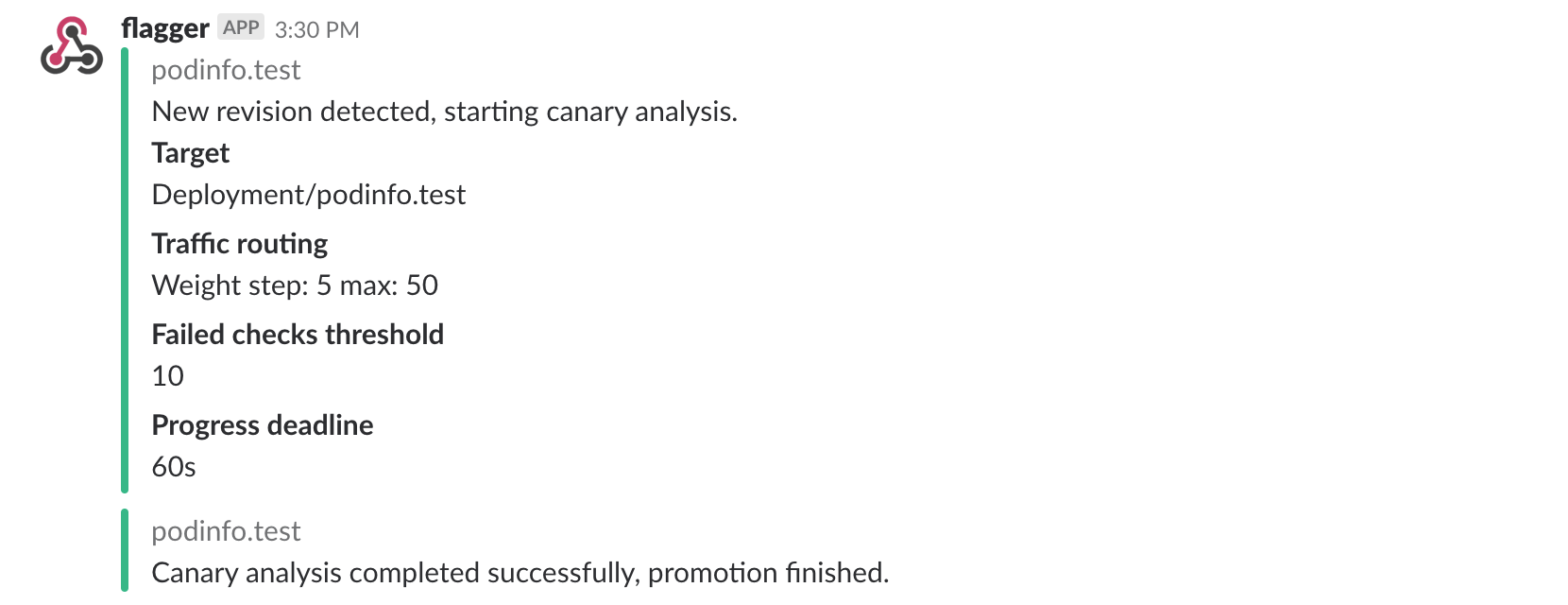
If you’ve enabled the Slack notifications, you should receive the following messages:
|
||
|
||
|
||
|
||
## Automated rollback
|
||
|
||
During the canary analysis you can generate HTTP 500 errors or high latency to test if Flagger pauses the rollout.
|
||
|
||
Trigger a canary deployment:
|
||
|
||
```bash
|
||
kubectl -n test set image deployment/podinfo \
|
||
podinfod=stefanprodan/podinfo:3.1.2
|
||
```
|
||
|
||
Exec into the load tester pod with:
|
||
|
||
```bash
|
||
kubectl -n test exec -it deploy/flagger-loadtester bash
|
||
```
|
||
|
||
Generate HTTP 500 errors:
|
||
|
||
```bash
|
||
hey -z 1m -c 5 -q 5 -H 'Host: podinfo.test' http://envoy.test:10000/status/500
|
||
```
|
||
|
||
Generate latency:
|
||
|
||
```bash
|
||
watch -n 1 curl -H 'Host: podinfo.test' http://envoy.test:10000/delay/1
|
||
```
|
||
|
||
When the number of failed checks reaches the canary analysis threshold, the traffic is routed back to the primary,
|
||
the canary is scaled to zero and the rollout is marked as failed.
|
||
|
||
```text
|
||
kubectl -n test logs deploy/flagger -f | jq .msg
|
||
|
||
New revision detected! progressing canary analysis for podinfo.test
|
||
Pre-rollout check acceptance-test passed
|
||
Advance podinfo.test canary weight 5
|
||
Advance podinfo.test canary weight 10
|
||
Advance podinfo.test canary weight 15
|
||
Halt podinfo.test advancement success rate 69.17% < 99%
|
||
Halt podinfo.test advancement success rate 61.39% < 99%
|
||
Halt podinfo.test advancement success rate 55.06% < 99%
|
||
Halt podinfo.test advancement request duration 1.20s > 0.5s
|
||
Halt podinfo.test advancement request duration 1.45s > 0.5s
|
||
Rolling back podinfo.test failed checks threshold reached 5
|
||
Canary failed! Scaling down podinfo.test
|
||
```
|
||
|
||
If you’ve enabled the Slack notifications, you’ll receive a message if the progress deadline is exceeded,
|
||
or if the analysis reached the maximum number of failed checks:
|
||
|
||

|
||
|