mirror of
https://github.com/fluxcd/flagger.git
synced 2026-04-15 06:57:34 +00:00

411 lines
11 KiB
Markdown
411 lines
11 KiB
Markdown
# Flagger install on Google Cloud
|
||
|
||
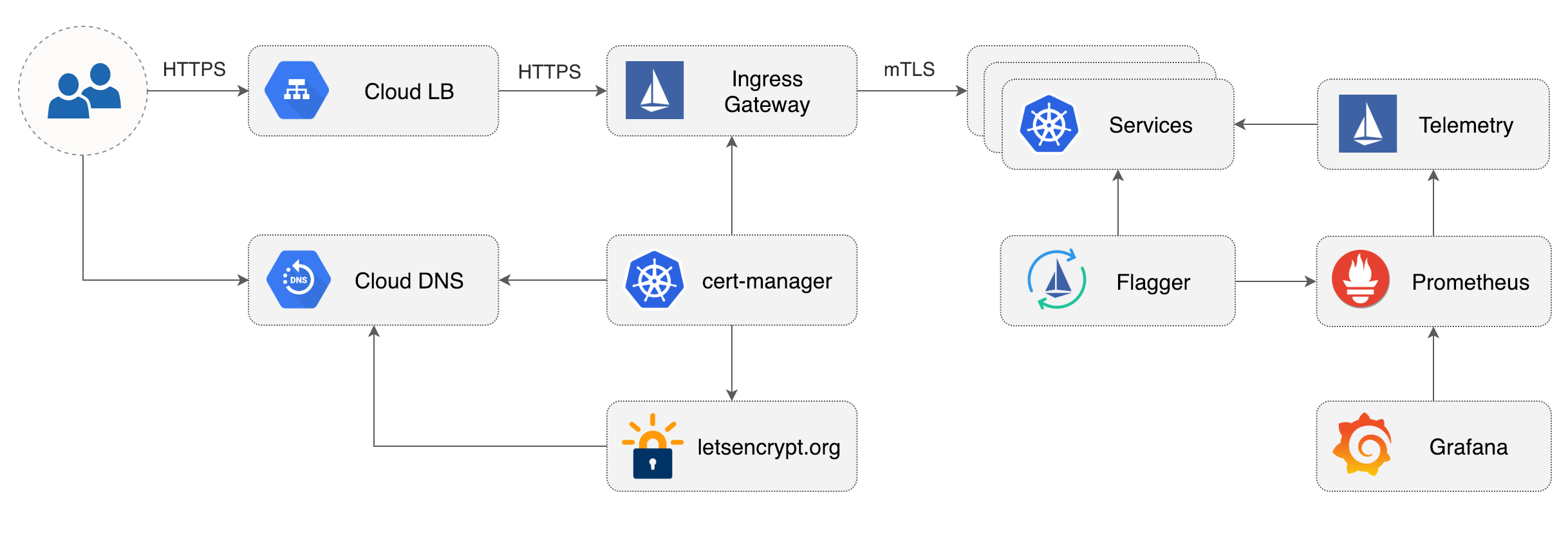
This guide walks you through setting up Flagger and Istio on Google Kubernetes Engine.
|
||
|
||
|
||
|
||
### Prerequisites
|
||
|
||
You will be creating a cluster on Google’s Kubernetes Engine \(GKE\),
|
||
if you don’t have an account you can sign up [here](https://cloud.google.com/free/) for free credits.
|
||
|
||
Login into Google Cloud, create a project and enable billing for it.
|
||
|
||
Install the [gcloud](https://cloud.google.com/sdk/) command line utility and configure your project with `gcloud init`.
|
||
|
||
Set the default project \(replace `PROJECT_ID` with your own project\):
|
||
|
||
```text
|
||
gcloud config set project PROJECT_ID
|
||
```
|
||
|
||
Set the default compute region and zone:
|
||
|
||
```text
|
||
gcloud config set compute/region us-central1
|
||
gcloud config set compute/zone us-central1-a
|
||
```
|
||
|
||
Enable the Kubernetes and Cloud DNS services for your project:
|
||
|
||
```text
|
||
gcloud services enable container.googleapis.com
|
||
gcloud services enable dns.googleapis.com
|
||
```
|
||
|
||
Install the kubectl command-line tool:
|
||
|
||
```text
|
||
gcloud components install kubectl
|
||
```
|
||
|
||
### GKE cluster setup
|
||
|
||
Create a cluster with the Istio add-on:
|
||
|
||
```bash
|
||
K8S_VERSION=$(gcloud container get-server-config --format=json \
|
||
| jq -r '.validMasterVersions[0]')
|
||
|
||
gcloud beta container clusters create istio \
|
||
--cluster-version=${K8S_VERSION} \
|
||
--zone=us-central1-a \
|
||
--num-nodes=2 \
|
||
--machine-type=n1-highcpu-4 \
|
||
--preemptible \
|
||
--no-enable-cloud-logging \
|
||
--no-enable-cloud-monitoring \
|
||
--disk-size=30 \
|
||
--enable-autorepair \
|
||
--addons=HorizontalPodAutoscaling,Istio \
|
||
--istio-config=auth=MTLS_PERMISSIVE
|
||
```
|
||
|
||
The above command will create a default node pool consisting of two `n1-highcpu-4` \(vCPU: 4, RAM 3.60GB, DISK: 30GB\)
|
||
preemptible VMs. Preemptible VMs are up to 80% cheaper than regular instances and are terminated and replaced
|
||
after a maximum of 24 hours.
|
||
|
||
Set up credentials for `kubectl`:
|
||
|
||
```bash
|
||
gcloud container clusters get-credentials istio
|
||
```
|
||
|
||
Create a cluster admin role binding:
|
||
|
||
```bash
|
||
kubectl create clusterrolebinding "cluster-admin-$(whoami)" \
|
||
--clusterrole=cluster-admin \
|
||
--user="$(gcloud config get-value core/account)"
|
||
```
|
||
|
||
Validate your setup with:
|
||
|
||
```bash
|
||
kubectl -n istio-system get svc
|
||
```
|
||
|
||
In a couple of seconds GCP should allocate an external IP to the `istio-ingressgateway` service.
|
||
|
||
### Cloud DNS setup
|
||
|
||
You will need an internet domain and access to the registrar to change the name servers to Google Cloud DNS.
|
||
|
||
Create a managed zone named `istio` in Cloud DNS \(replace `example.com` with your domain\):
|
||
|
||
```bash
|
||
gcloud dns managed-zones create \
|
||
--dns-name="example.com." \
|
||
--description="Istio zone" "istio"
|
||
```
|
||
|
||
Look up your zone's name servers:
|
||
|
||
```bash
|
||
gcloud dns managed-zones describe istio
|
||
```
|
||
|
||
Update your registrar's name server records with the records returned by the above command.
|
||
|
||
Wait for the name servers to change \(replace `example.com` with your domain\):
|
||
|
||
```bash
|
||
watch dig +short NS example.com
|
||
```
|
||
|
||
Create a static IP address named `istio-gateway` using the Istio ingress IP:
|
||
|
||
```bash
|
||
export GATEWAY_IP=$(kubectl -n istio-system get svc/istio-ingressgateway -ojson \
|
||
| jq -r .status.loadBalancer.ingress[0].ip)
|
||
|
||
gcloud compute addresses create istio-gateway --addresses ${GATEWAY_IP} --region us-central1
|
||
```
|
||
|
||
Create the following DNS records \(replace `example.com` with your domain\):
|
||
|
||
```bash
|
||
DOMAIN="example.com"
|
||
|
||
gcloud dns record-sets transaction start --zone=istio
|
||
|
||
gcloud dns record-sets transaction add --zone=istio \
|
||
--name="${DOMAIN}" --ttl=300 --type=A ${GATEWAY_IP}
|
||
|
||
gcloud dns record-sets transaction add --zone=istio \
|
||
--name="www.${DOMAIN}" --ttl=300 --type=A ${GATEWAY_IP}
|
||
|
||
gcloud dns record-sets transaction add --zone=istio \
|
||
--name="*.${DOMAIN}" --ttl=300 --type=A ${GATEWAY_IP}
|
||
|
||
gcloud dns record-sets transaction execute --zone istio
|
||
```
|
||
|
||
Verify that the wildcard DNS is working \(replace `example.com` with your domain\):
|
||
|
||
```bash
|
||
watch host test.example.com
|
||
```
|
||
|
||
### Install Helm
|
||
|
||
Install the [Helm](https://docs.helm.sh/using_helm/#installing-helm) command-line tool:
|
||
|
||
```text
|
||
brew install kubernetes-helm
|
||
```
|
||
|
||
Create a service account and a cluster role binding for Tiller:
|
||
|
||
```bash
|
||
kubectl -n kube-system create sa tiller
|
||
|
||
kubectl create clusterrolebinding tiller-cluster-rule \
|
||
--clusterrole=cluster-admin \
|
||
--serviceaccount=kube-system:tiller
|
||
```
|
||
|
||
Deploy Tiller in the `kube-system` namespace:
|
||
|
||
```bash
|
||
helm init --service-account tiller
|
||
```
|
||
|
||
You should consider using SSL between Helm and Tiller, for more information on securing your Helm
|
||
installation see [docs.helm.sh](https://docs.helm.sh/using_helm/#securing-your-helm-installation).
|
||
|
||
### Install cert-manager
|
||
|
||
Jetstack's [cert-manager](https://github.com/jetstack/cert-manager)
|
||
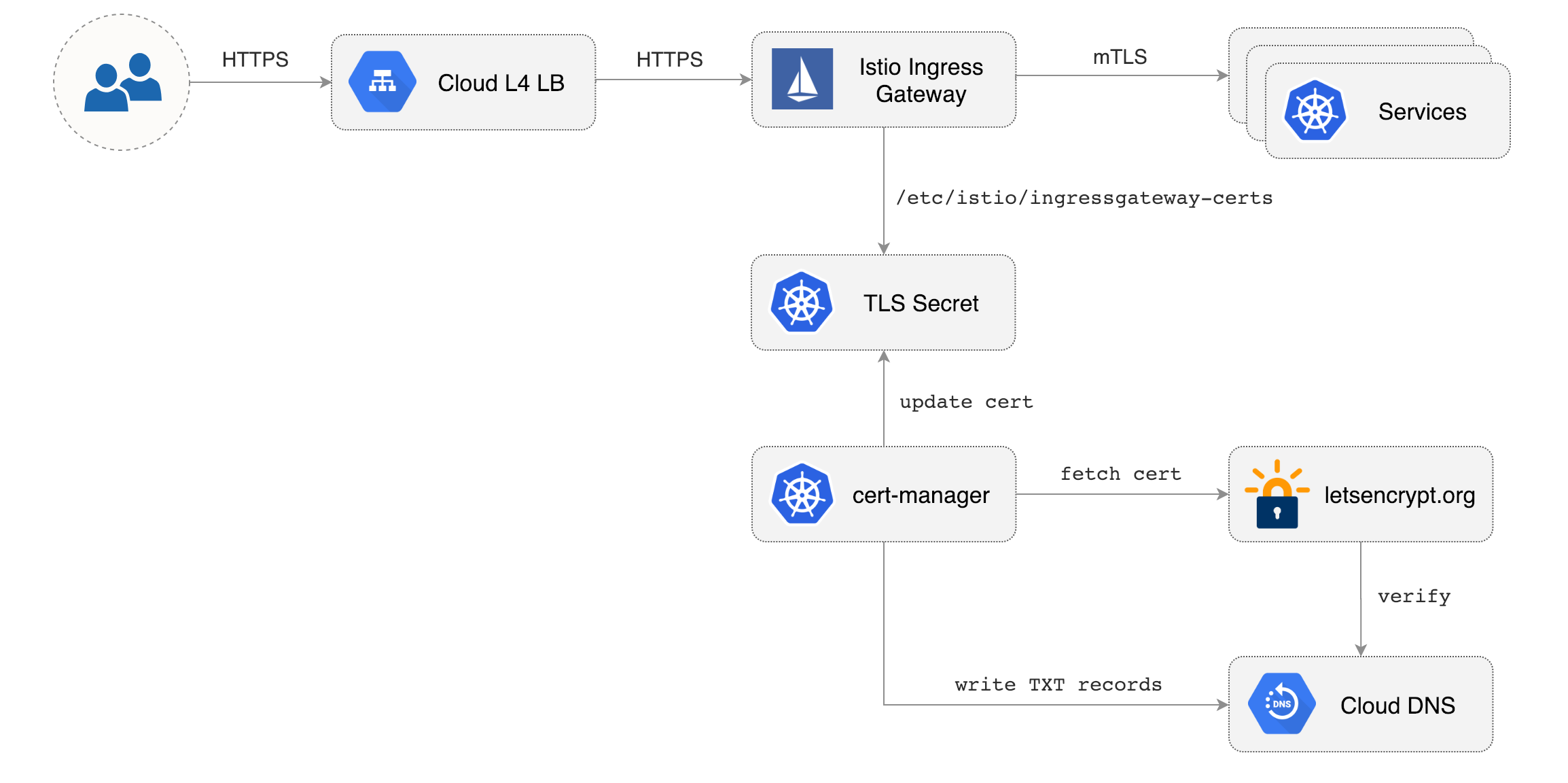
is a Kubernetes operator that automatically creates and manages TLS certs issued by Let’s Encrypt.
|
||
|
||
You'll be using cert-manager to provision a wildcard certificate for the Istio ingress gateway.
|
||
|
||
Install cert-manager's CRDs:
|
||
|
||
```bash
|
||
CERT_REPO=https://raw.githubusercontent.com/jetstack/cert-manager
|
||
|
||
kubectl apply -f ${CERT_REPO}/release-0.10/deploy/manifests/00-crds.yaml
|
||
```
|
||
|
||
Create the cert-manager namespace and disable resource validation:
|
||
|
||
```bash
|
||
kubectl create namespace cert-manager
|
||
|
||
kubectl label namespace cert-manager certmanager.k8s.io/disable-validation=true
|
||
```
|
||
|
||
Install cert-manager with Helm:
|
||
|
||
```bash
|
||
helm repo add jetstack https://charts.jetstack.io && \
|
||
helm repo update && \
|
||
helm upgrade -i cert-manager \
|
||
--namespace cert-manager \
|
||
--version v0.10.0 \
|
||
jetstack/cert-manager
|
||
```
|
||
|
||
### Istio Gateway TLS setup
|
||
|
||
|
||
|
||
Create a generic Istio Gateway to expose services outside the mesh on HTTPS:
|
||
|
||
```bash
|
||
REPO=https://raw.githubusercontent.com/weaveworks/flagger/master
|
||
|
||
kubectl apply -f ${REPO}/artifacts/gke/istio-gateway.yaml
|
||
```
|
||
|
||
Create a service account with Cloud DNS admin role \(replace `my-gcp-project` with your project ID\):
|
||
|
||
```bash
|
||
GCP_PROJECT=my-gcp-project
|
||
|
||
gcloud iam service-accounts create dns-admin \
|
||
--display-name=dns-admin \
|
||
--project=${GCP_PROJECT}
|
||
|
||
gcloud iam service-accounts keys create ./gcp-dns-admin.json \
|
||
--iam-account=dns-admin@${GCP_PROJECT}.iam.gserviceaccount.com \
|
||
--project=${GCP_PROJECT}
|
||
|
||
gcloud projects add-iam-policy-binding ${GCP_PROJECT} \
|
||
--member=serviceAccount:dns-admin@${GCP_PROJECT}.iam.gserviceaccount.com \
|
||
--role=roles/dns.admin
|
||
```
|
||
|
||
Create a Kubernetes secret with the GCP Cloud DNS admin key:
|
||
|
||
```bash
|
||
kubectl create secret generic cert-manager-credentials \
|
||
--from-file=./gcp-dns-admin.json \
|
||
--namespace=istio-system
|
||
```
|
||
|
||
Create a letsencrypt issuer for CloudDNS \(replace `email@example.com` with a valid email address and
|
||
`my-gcp-project`with your project ID\):
|
||
|
||
```yaml
|
||
apiVersion: certmanager.k8s.io/v1alpha1
|
||
kind: Issuer
|
||
metadata:
|
||
name: letsencrypt-prod
|
||
namespace: istio-system
|
||
spec:
|
||
acme:
|
||
server: https://acme-v02.api.letsencrypt.org/directory
|
||
email: email@example.com
|
||
privateKeySecretRef:
|
||
name: letsencrypt-prod
|
||
dns01:
|
||
providers:
|
||
- name: cloud-dns
|
||
clouddns:
|
||
serviceAccountSecretRef:
|
||
name: cert-manager-credentials
|
||
key: gcp-dns-admin.json
|
||
project: my-gcp-project
|
||
```
|
||
|
||
Save the above resource as letsencrypt-issuer.yaml and then apply it:
|
||
|
||
```text
|
||
kubectl apply -f ./letsencrypt-issuer.yaml
|
||
```
|
||
|
||
Create a wildcard certificate \(replace `example.com` with your domain\):
|
||
|
||
```yaml
|
||
apiVersion: certmanager.k8s.io/v1alpha1
|
||
kind: Certificate
|
||
metadata:
|
||
name: istio-gateway
|
||
namespace: istio-system
|
||
spec:
|
||
secretName: istio-ingressgateway-certs
|
||
issuerRef:
|
||
name: letsencrypt-prod
|
||
commonName: "*.example.com"
|
||
acme:
|
||
config:
|
||
- dns01:
|
||
provider: cloud-dns
|
||
domains:
|
||
- "*.example.com"
|
||
- "example.com"
|
||
```
|
||
|
||
Save the above resource as istio-gateway-cert.yaml and then apply it:
|
||
|
||
```text
|
||
kubectl apply -f ./istio-gateway-cert.yaml
|
||
```
|
||
|
||
In a couple of seconds cert-manager should fetch a wildcard certificate from letsencrypt.org:
|
||
|
||
```text
|
||
kubectl -n istio-system describe certificate istio-gateway
|
||
|
||
Events:
|
||
Type Reason Age From Message
|
||
---- ------ ---- ---- -------
|
||
Normal CertIssued 1m52s cert-manager Certificate issued successfully
|
||
```
|
||
|
||
Recreate Istio ingress gateway pods:
|
||
|
||
```bash
|
||
kubectl -n istio-system get pods -l istio=ingressgateway
|
||
```
|
||
|
||
Note that Istio gateway doesn't reload the certificates from the TLS secret on cert-manager renewal.
|
||
Since the GKE cluster is made out of preemptible VMs the gateway pods will be replaced once every 24h,
|
||
if your not using preemptible nodes then you need to manually delete the gateway pods every two months
|
||
before the certificate expires.
|
||
|
||
### Install Prometheus
|
||
|
||
The GKE Istio add-on does not include a Prometheus instance that scrapes the Istio telemetry service.
|
||
Because Flagger uses the Istio HTTP metrics to run the canary analysis you have to deploy the following
|
||
Prometheus configuration that's similar to the one that comes with the official Istio Helm chart.
|
||
|
||
Find the GKE Istio version with:
|
||
|
||
```bash
|
||
kubectl -n istio-system get deploy istio-pilot -oyaml | grep image:
|
||
```
|
||
|
||
Install Prometheus in istio-system namespace:
|
||
|
||
```bash
|
||
kubectl -n istio-system apply -f \
|
||
https://storage.googleapis.com/gke-release/istio/release/1.0.6-gke.3/patches/install-prometheus.yaml
|
||
```
|
||
|
||
### Install Flagger and Grafana
|
||
|
||
Add Flagger Helm repository:
|
||
|
||
```bash
|
||
helm repo add flagger https://flagger.app
|
||
```
|
||
|
||
Install Flagger's Canary CRD:
|
||
|
||
```yaml
|
||
kubectl apply -f https://raw.githubusercontent.com/weaveworks/flagger/master/artifacts/flagger/crd.yaml
|
||
```
|
||
|
||
Deploy Flagger in the `istio-system` namespace with Slack notifications enabled:
|
||
|
||
```bash
|
||
helm upgrade -i flagger flagger/flagger \
|
||
--namespace=istio-system \
|
||
--set crd.create=false \
|
||
--set metricsServer=http://prometheus.istio-system:9090 \
|
||
--set slack.url=https://hooks.slack.com/services/YOUR/SLACK/WEBHOOK \
|
||
--set slack.channel=general \
|
||
--set slack.user=flagger
|
||
```
|
||
|
||
Deploy Grafana in the `istio-system` namespace:
|
||
|
||
```bash
|
||
helm upgrade -i flagger-grafana flagger/grafana \
|
||
--namespace=istio-system \
|
||
--set url=http://prometheus.istio-system:9090 \
|
||
--set user=admin \
|
||
--set password=replace-me
|
||
```
|
||
|
||
Expose Grafana through the public gateway by creating a virtual service \(replace `example.com` with your domain\):
|
||
|
||
```yaml
|
||
apiVersion: networking.istio.io/v1alpha3
|
||
kind: VirtualService
|
||
metadata:
|
||
name: grafana
|
||
namespace: istio-system
|
||
spec:
|
||
hosts:
|
||
- "grafana.example.com"
|
||
gateways:
|
||
- public-gateway.istio-system.svc.cluster.local
|
||
http:
|
||
- route:
|
||
- destination:
|
||
host: flagger-grafana
|
||
```
|
||
|
||
Save the above resource as grafana-virtual-service.yaml and then apply it:
|
||
|
||
```bash
|
||
kubectl apply -f ./grafana-virtual-service.yaml
|
||
```
|
||
|
||
Navigate to `http://grafana.example.com` in your browser and you should be redirected to the HTTPS version.
|