
🔏 X.509 Certificate Exporter


A Prometheus exporter for certificates focusing on expiration monitoring, written in Go with cloud deployments in mind.
Get notified before they expire:
- TLS Secrets from a Kubernetes cluster
- PEM encoded files, by path or scanning directories
- Kubeconfigs with embedded certificates or file references
The following metrics are available:
x509_cert_not_beforex509_cert_not_afterx509_cert_expiredx509_cert_error(optional)x509_read_errors
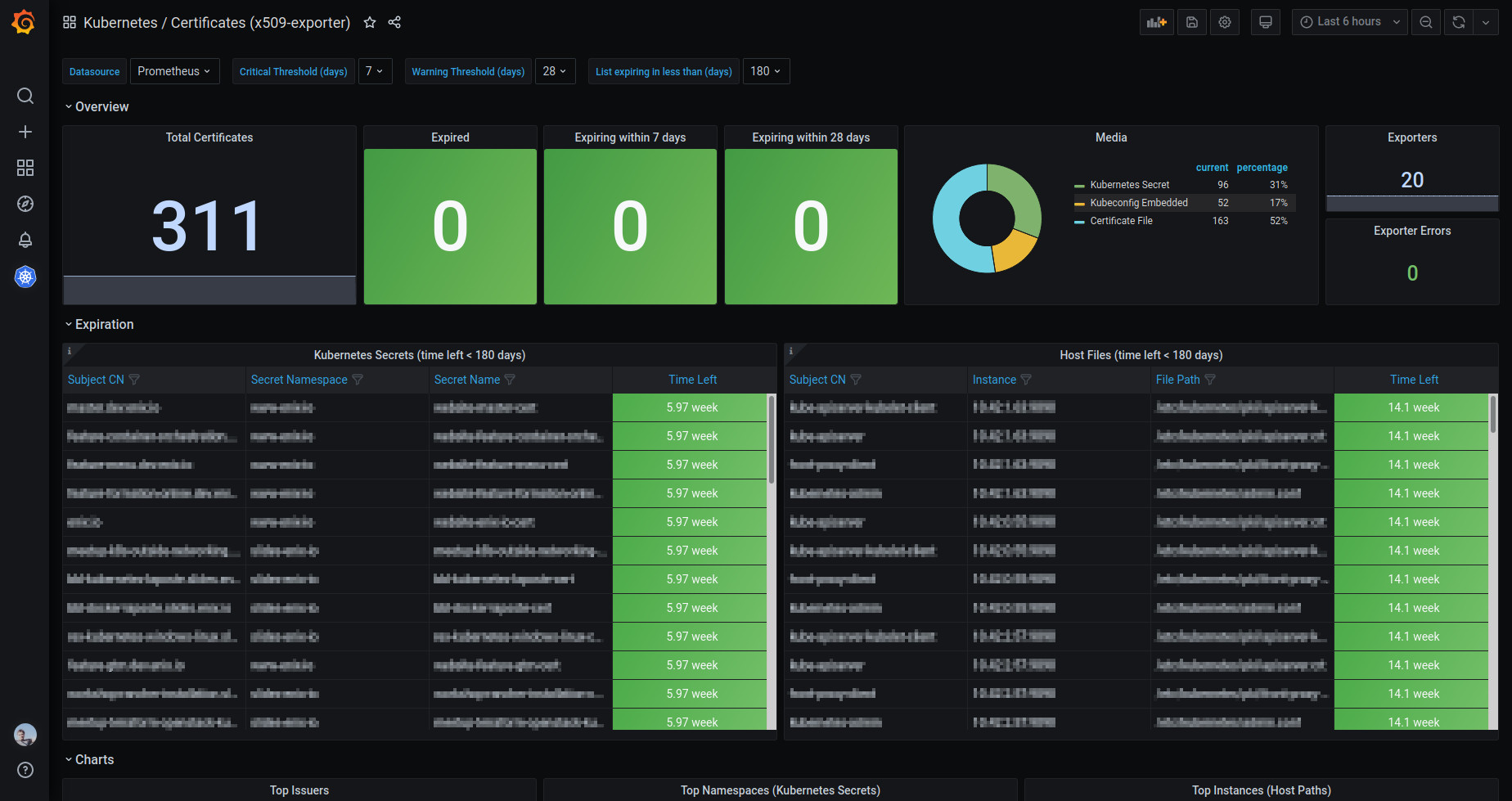
Best when used with the Grafana Dashboard ID 13922:
🏃 TL;DR
It only takes two commands to install x509-certificate-exporter, however you should read the instructions in the next section to take advantage of all the features!
Add our Charts repository :
$ helm repo add enix https://charts.enix.io
Install x509-certificate-exporter for TLS Secrets monitoring with prometheus-operator support :
$ helm install x509-certificate-exporter enix/x509-certificate-exporter
To remove built-in Prometheus alerts if you'd rather craft your own :
$ helm upgrade x509-certificate-exporter enix/x509-certificate-exporter --reuse-values --set prometheusRules.create=false
If you don't use the Prometheus operator at all, and don't have the CRD, disable resource creation and perhaps add Pod annotations for scrapping :
secretsExporter:
  podAnnotations:
    prometheus.io/port: "9793"
    prometheus.io/scrape: "true"
service:
  create: false
prometheusServiceMonitor:
  create: false
prometheusRules:
  create: false
📜 Using the Chart
This will guide you through writing the initial set of values.
Metrics for TLS Secrets
By default we only run a Deployment to provide metrics on TLS Secrets stored in the Kubernetes cluster. It helps detect expiring certificates whether you manage them on your own or rely on controllers such as cert-manager.
🙂 If you're only interested in this feature, you could probably install the Chart not specifying any value.
Disable this exporter when Secrets metrics are not wanted – if you're looking for hostPath DaemonSets only :
secretsExporter:
  enabled: false
Metrics for node certificates (hostPath)
Kubernetes components use many certificates to authenticate and secure communications between each others. This PKI is critical to the operation of a cluster and its health should be monitored carefully. Expiring Kubernetes certificates are a common source of outages, and depending on your distribution could happen a few months after installation if left unattended.
This Chart provides a facility to deploy DaemonSets so that each node of a cluster can run its own x509-certificate-exporter
and export metrics for host files :
etcdserver and client certificates- Kubernetes CA
kube-apiservercertificateskubeletcertificates- kubeconfig files with embedded certificates
- etc. Obviously it also works with any other application deployed on cluster nodes as long as it uses PEM encoded certicates (deployment agents, security tools, etc.).
⚙️ You'll have to compile a list of files and directories of interest. There is no "one size fits all" configuration that we could recommend, or even a decent boilerplate. Examples below should give an idea of what to look after.
🏙️ While having a single DaemonSet sounds like a fair option, it is not uncommon for nodes to assume different roles, and as a result hold different sets of certificate files requiring targeted x509-certificate-exporter configurations. For example, with the help of node selectors and tolerations, we can have nodes of the control plane run their own exporter targeting API and etcd certificates, while regular nodes would have a simpler configuration for Kubelet alone.
Deployment of hostPath exporters is controlled under the hostPathsExporter key of Chart Values.
All values are defaults that would apply to any number of DaemonSet you wish to run, unless overridden individually.
Then you'll need to create at least one DaemonSet in hostPathsExporter.daemonSets.
This is the most basic configuration. It will create one DaemonSet named nodes with an empty configuration. Exporters
won't export no certificate metric.
hostPathsExporter:
  daemonSets:
    nodes: {}
Moving on, we can add all flavors of "watch" settings :
watchDirectories: to monitor all PEM files found in a host directory (no recursion in subdirectories)watchFiles: to target known file paths, this is highly recommended over the directory option when file paths are predictablewatchKubeconfFiles: look for base64 encoded embedded certificates in Kubeconfig files
This will create a DaemonSet able to monitor the same files on all nodes. It could fit a typical kubeadm cluster with no control plane dedicated nodes :
hostPathsExporter:
  daemonSets:
    nodes:
      watchFiles:
      - /var/lib/kubelet/pki/kubelet-client-current.pem
      - /etc/kubernetes/pki/apiserver.crt
      - /etc/kubernetes/pki/apiserver-etcd-client.crt
      - /etc/kubernetes/pki/apiserver-kubelet-client.crt
      - /etc/kubernetes/pki/ca.crt
      - /etc/kubernetes/pki/front-proxy-ca.crt
      - /etc/kubernetes/pki/front-proxy-client.crt
      - /etc/kubernetes/pki/etcd/ca.crt
      - /etc/kubernetes/pki/etcd/healthcheck-client.crt
      - /etc/kubernetes/pki/etcd/peer.crt
      - /etc/kubernetes/pki/etcd/server.crt
      watchKubeconfFiles:
      - /etc/kubernetes/admin.conf
      - /etc/kubernetes/controller-manager.conf
      - /etc/kubernetes/scheduler.conf
Dedicated nodes will require other DaemonSets. Based on our kubeadm example, it could be extended like this :
hostPathsExporter:
  podAnnotations:
    prometheus.io/port: "9793"
    prometheus.io/scrape: "true"

  daemonSets:
    cp:
      nodeSelector:
        node-role.kubernetes.io/master: ""
      tolerations:
      - effect: NoSchedule
        key: node-role.kubernetes.io/master
        operator: Exists
      watchFiles:
      - /var/lib/kubelet/pki/kubelet-client-current.pem
      - /etc/kubernetes/pki/apiserver.crt
      - /etc/kubernetes/pki/apiserver-etcd-client.crt
      - /etc/kubernetes/pki/apiserver-kubelet-client.crt
      - /etc/kubernetes/pki/ca.crt
      - /etc/kubernetes/pki/front-proxy-ca.crt
      - /etc/kubernetes/pki/front-proxy-client.crt
      - /etc/kubernetes/pki/etcd/ca.crt
      - /etc/kubernetes/pki/etcd/healthcheck-client.crt
      - /etc/kubernetes/pki/etcd/peer.crt
      - /etc/kubernetes/pki/etcd/server.crt
      watchKubeconfFiles:
      - /etc/kubernetes/admin.conf
      - /etc/kubernetes/controller-manager.conf
      - /etc/kubernetes/scheduler.conf

    nodes:
      tolerations:
      - effect: NoSchedule
        key: node-role.kubernetes.io/ingress
        operator: Exists
      watchFiles:
      - /var/lib/kubelet/pki/kubelet-client-current.pem
      - /etc/kubernetes/pki/ca.crt
With this last configuration we demonstrated :
- using
podAnnotationsright underhostPathsExporter, it will apply to allhostPathsExporter.daemonSetsbecause they don't override that setting - two DaemonSets,
cpfor control plane nodes, andnodesfor regular ones nodeSelectoron the control plane DaemonSet to schedule Pods on "masters" onlytolerationsfor both. Oncpit's required to be scheduled on those tainted nodes. Because this cluster would also have nodes dedicated to ingress controllers, DaemonSetnodesalso get a toleration for this role.
Custom Resources for the Prometheus operator
Users of the prometheus-operator will immediately scrape exporters thanks to the creation of a ServiceMonitor
resource, and get basic alerting rules from the new PrometheusRule.
The operator is usually installed with kube-prometheus or by
the Kubernetes distribution.
When it's missing and you don't have the CRD, helm will raise one of this error :
Error: unable to build kubernetes objects from release manifest: [unable to recognize "": no matches for kind "PrometheusRule" in version "monitoring.coreos.com/v1", unable to recognize "": no matches for kind "ServiceMonitor" in version "monitoring.coreos.com/v1"]
Add the following values to disable creation of ServiceMonitors and PrometheusRules :
prometheusServiceMonitor:
  create: false
prometheusRules:
  create: false
Then perhaps you would need Pod annotations to work with the Kubernetes service discovery in Prometheus :
secretsExporter:
  podAnnotations:
    prometheus.io/port: "9793"
    prometheus.io/scrape: "true"
Also in such case the headless service may not serve any purpose and can be removed :
service:
  create: false
ℹ️ Chart Values provide a few knobs to control Prometheus rules, such as numbers of days before certificate expiration for warning and critical alerts are triggered.
⚠️ Special alert
X509ExporterReadErrorsis meant to report anomalies with the exporter, such as API authorization issues or unreadable files. If the Kubernetes API is unstable it could be disabled withprometheusRules.alertOnReadErrors.
When using hostPath exporters, and some nodes don't have all the files, it's better to add other DaemonSet profiles to target each situation and preserve this alert. Detecting configuration regressions is especially important when working with files that can change path over time and on cluster upgrades.
Installing the Chart
Create a file named x509-certificate-exporter.values.yaml with your values, as discussed previously and with the help of
Chart Values.
Add our Charts repository :
$ helm repo add enix https://charts.enix.io
Install the x509-certificate-exporter with release name x509-certificate-exporter :
$ helm install x509-certificate-exporter enix/x509-certificate-exporter --values x509-certificate-exporter.values.yaml
The upgrade command is used to change configuration when values are modified :
$ helm upgrade x509-certificate-exporter enix/x509-certificate-exporter --values x509-certificate-exporter.values.yaml
Upgrading the Chart
Update Helm repositories :
$ helm repo update
Upgrade release names x509-certificate-exporter to the latest version :
$ helm upgrade x509-certificate-exporter enix/x509-certificate-exporter
📝 Notes
watchFiles and inode change
Because of limitations with mount binding that CRIs use to expose a single host file to a container, we cannot use
subPath in volumeMounts. This feature would in fact result in the perfect implementation where the exporter can only
access designated files. However if a certificate file is not replaced in-place and it's inode is altered, the exporter
would keep seeing the old content and can't even tell if it still exists on the host. This situation is common with
Kubernetes control-plane certificates.
Be aware that for every file path provided to watchFiles, the exporter container will be given read access to the
parent directory. This is how we handle the problem of changing inodes. Metrics will of course be limited to the single
targetted path, as the program is told to watch the real path from watchFiles.
This is to be taken into consideration if you're doing threat assessment. In such case it's recommended not to put secret keys in the same directory as certificate files.
Watching symbolic links
Starting with version 2.6.0, the exporter is now handling symlinks in a special way to better suit containerization and the limited access to host filesystem.
When a symlink is added to a watchFiles list, we are able to resolve and read it's target as long as it's in the same
directory. This is dynamic for each metrics scrape and will track symlink changes.
A typical case of this is the Kubelet client certificate that now uses a symlink pointing to a new file each time the certificate gets rotated. For instance you may be using :
watchFiles:
- /var/lib/kubelet/pki/kubelet-client-current.pem
Because all client certificates reside in the pki directory, the exporter will be able to read
kubelet-client-current.pem and it's target properly. Even though the Operating System cannot resolve the link itself
in the container namespace.
Values
| Key | Type | Default | Description |
|---|---|---|---|
| kubeVersion | string | "" |
Override Kubernetes version detection ; usefull with "helm template" |
| extraLabels | object | {} |
Extra labels to add on chart resources |
| nameOverride | string | "" |
Partially override x509-certificate-exporter.fullname template (will prepend the release name) |
| fullnameOverride | string | "" |
Fully override x509-certificate-exporter.fullname template |
| imagePullSecrets | list | [] |
Specify docker-registry secret names as an array |
| image.registry | string | "docker.io" |
x509-certificate-exporter image registry |
| image.repository | string | "enix/x509-certificate-exporter" |
x509-certificate-exporter image repository |
| image.tag | string | nil |
x509-certificate-exporter image tag (defaults to Chart appVersion) |
| image.pullPolicy | string | "IfNotPresent" |
x509-certificate-exporter image pull policy |
| psp.create | bool | false |
Should Pod Security Policy resources be created |
| rbac.create | bool | true |
Should RBAC resources be created |
| rbac.secretsExporter.serviceAccountName | string | nil |
Name of the ServiceAccount for the Secrets exporter (required if rbac.create=false) |
| rbac.secretsExporter.serviceAccountAnnotations | object | {} |
Annotations added to the ServiceAccount for the Secrets exporter |
| rbac.secretsExporter.clusterRoleAnnotations | object | {} |
Annotations added to the ClusterRole for the Secrets exporter |
| rbac.secretsExporter.clusterRoleBindingAnnotations | object | {} |
Annotations added to the ClusterRoleBinding for the Secrets exporter |
| rbac.hostPathsExporter.serviceAccountName | string | nil |
Name of the ServiceAccount for hostPath exporters (required if rbac.create=false) |
| rbac.hostPathsExporter.serviceAccountAnnotations | object | {} |
Annotations added to the ServiceAccount for the hostPath exporters |
| rbac.hostPathsExporter.clusterRoleAnnotations | object | {} |
Annotations added to the ClusterRole for the hostPath exporters |
| rbac.hostPathsExporter.clusterRoleBindingAnnotations | object | {} |
Annotations added to the ClusterRoleBinding for the hostPath exporters |
| podExtraLabels | object | {} |
Extra labels added to all Pods |
| podAnnotations | object | {} |
Annotations added to all Pods |
| exposePerCertificateErrorMetrics | bool | false |
Enable additional metrics to report per-certificate errors ; helps with identifying read errors origin not having to look at exporter logs, at the expense of additional storage on Prometheus |
| exposeRelativeMetrics | bool | false |
Enable additional metrics with relative durations instead of absolute timestamps ; not recommended with Prometheus |
| metricLabelsFilterList | list | nil |
Restrict metric labels to this list if set. Warning : use with caution as reducing cardinality may yield metrics collisions and force the exporter to ignore certificates. This will also degrade the usability of the Grafana dashboard. This list should always include at least filepath, secret_namespace and secret_name. Also subject_CN is highly recommended for when a file contains multiple certificates. |
| secretsExporter.enabled | bool | true |
Should the TLS Secrets exporter be running |
| secretsExporter.debugMode | bool | false |
Should debug messages be produced by the TLS Secrets exporter |
| secretsExporter.replicas | int | 1 |
Desired number of TLS Secrets exporter Pod |
| secretsExporter.restartPolicy | string | "Always" |
restartPolicy for Pods of the TLS Secrets exporter |
| secretsExporter.strategy | object | {} |
DeploymentStrategy for the TLS Secrets exporter |
| secretsExporter.resources | object | check values.yaml |
ResourceRequirements for containers of the TLS Secrets exporter |
| secretsExporter.nodeSelector | object | {} |
Node selector for Pods of the TLS Secrets exporter |
| secretsExporter.tolerations | list | [] |
Toleration for Pods of the TLS Secrets exporter |
| secretsExporter.affinity | object | {} |
Affinity for Pods of the TLS Secrets exporter |
| secretsExporter.podExtraLabels | object | {} |
Extra labels added to Pods of the TLS Secrets exporter |
| secretsExporter.podAnnotations | object | {} |
Annotations added to Pods of the TLS Secrets exporter |
| secretsExporter.podSecurityContext | object | {} |
PodSecurityContext for Pods of the TLS Secrets exporter |
| secretsExporter.securityContext | object | check values.yaml |
SecurityContext for containers of the TLS Secrets exporter |
| secretsExporter.secretTypes | list | check values.yaml |
Which type of Secrets should be watched ; "key" is the map key in the secret data |
| secretsExporter.includeNamespaces | list | [] |
Restrict the list of namespaces the TLS Secrets exporter should scan for certificates to watch (all namespaces if empty) |
| secretsExporter.excludeNamespaces | list | [] |
Exclude namespaces from being scanned by the TLS Secrets exporter (evaluated after includeNamespaces) |
| secretsExporter.includeLabels | list | [] |
Only watch TLS Secrets having these labels (all secrets if empty). Items can be keys such as my-label or also require a value with syntax my-label=my-value. |
| secretsExporter.excludeLabels | list | [] |
Exclude TLS Secrets having these labels. Items can be keys such as my-label or also require a value with syntax my-label=my-value. |
| secretsExporter.cache.enabled | bool | true |
Enable caching of Kubernetes resources to prevent scraping timeouts |
| secretsExporter.cache.maxDuration | int | 300 |
Maximum time a resource can stay in cache unrefreshed (seconds) - it will be at least half of that |
| hostPathsExporter.debugMode | bool | false |
Should debug messages be produced by hostPath exporters (default for all hostPathsExporter.daemonSets) |
| hostPathsExporter.restartPolicy | string | "Always" |
restartPolicy for Pods of hostPath exporters (default for all hostPathsExporter.daemonSets) |
| hostPathsExporter.updateStrategy | object | {} |
updateStrategy for DaemonSet of hostPath exporters (default for all hostPathsExporter.daemonSets) |
| hostPathsExporter.resources | object | check values.yaml |
ResourceRequirements for containers of hostPath exporters (default for all hostPathsExporter.daemonSets) |
| hostPathsExporter.nodeSelector | object | {} |
Node selector for Pods of hostPath exporters (default for all hostPathsExporter.daemonSets) |
| hostPathsExporter.tolerations | list | [] |
Toleration for Pods of hostPath exporters (default for all hostPathsExporter.daemonSets) |
| hostPathsExporter.affinity | object | {} |
Affinity for Pods of hostPath exporters (default for all hostPathsExporter.daemonSets) |
| hostPathsExporter.podExtraLabels | object | {} |
Extra labels added to Pods of hostPath exporters (default for all hostPathsExporter.daemonSets) |
| hostPathsExporter.podAnnotations | object | {} |
Annotations added to Pods of hostPath exporters (default for all hostPathsExporter.daemonSets) |
| hostPathsExporter.podSecurityContext | object | {} |
PodSecurityContext for Pods of hostPath exporters (default for all hostPathsExporter.daemonSets) |
| hostPathsExporter.securityContext | object | check values.yaml |
SecurityContext for containers of hostPath exporters (default for all hostPathsExporter.daemonSets) |
| hostPathsExporter.watchDirectories | list | [] |
[SEE README] List of directory paths of the host to scan for PEM encoded certificate files to be watched and exported as metrics (one level deep) |
| hostPathsExporter.watchFiles | list | [] |
[SEE README] List of file paths of the host for PEM encoded certificates to be watched and exported as metrics (one level deep) |
| hostPathsExporter.watchKubeconfFiles | list | [] |
[SEE README] List of Kubeconf file paths of the host to scan for embedded certificates to export metrics about |
| hostPathsExporter.daemonSets | object | {} |
[SEE README] Map to define one or many DaemonSets running hostPath exporters. Key is used as a name ; value is a map to override all default settings set by hostPathsExporter.*. |
| rbacProxy.enabled | bool | false |
Should kube-rbac-proxy be used to expose exporters |
| rbacProxy.image.registry | string | "quay.io" |
kube-rbac-proxy image registry |
| rbacProxy.image.repository | string | "coreos/kube-rbac-proxy" |
kube-rbac-proxy image repository |
| rbacProxy.image.tag | string | "v0.5.0" |
kube-rbac-proxy image version |
| rbacProxy.image.pullPolicy | string | "IfNotPresent" |
kube-rbac-proxy image pull policy |
| rbacProxy.upstreamListenPort | int | 9091 |
Listen port for the exporter running inside kube-rbac-proxy exposed Pods |
| rbacProxy.resources | object | check values.yaml |
ResourceRequirements for all containers of kube-rbac-proxy |
| rbacProxy.securityContext | object | check values.yaml |
SecurityContext for all containers of kube-rbac-proxy |
| podListenPort | int | 9793 |
TCP port to expose Pods on (whether kube-rbac-proxy is enabled or not) |
| hostNetwork | bool | false |
Enable hostNetwork mode. Useful when Prometheus is deployed outside of the Kubernetes cluster |
| service.create | bool | true |
Should a headless Service be installed, targets all instances Deployment and DaemonSets (required for ServiceMonitor) |
| service.port | int | 9793 |
TCP port to expose the Service on |
| service.annotations | object | {} |
Annotations to add to the Service |
| service.extraLabels | object | {} |
Extra labels to add to the Service |
| prometheusServiceMonitor.create | bool | true |
Should a ServiceMonitor ressource be installed to scrape this exporter. For prometheus-operator (kube-prometheus) users. |
| prometheusServiceMonitor.scrapeInterval | string | "60s" |
Target scrape interval set in the ServiceMonitor |
| prometheusServiceMonitor.scrapeTimeout | string | "30s" |
Target scrape timeout set in the ServiceMonitor |
| prometheusServiceMonitor.extraLabels | object | {} |
Extra labels to add on ServiceMonitor ressources |
| prometheusServiceMonitor.relabelings | object | {} |
Relabel config for the ServiceMonitor, see: https://coreos.com/operators/prometheus/docs/latest/api.html#relabelconfig |
| prometheusPodMonitor.create | bool | false |
Should a PodMonitor ressource be installed to scrape this exporter. For prometheus-operator (kube-prometheus) users. |
| prometheusPodMonitor.scrapeInterval | string | "60s" |
Target scrape interval set in the PodMonitor |
| prometheusPodMonitor.scrapeTimeout | string | "30s" |
Target scrape timeout set in the PodMonitor |
| prometheusPodMonitor.extraLabels | object | {} |
Extra labels to add on PodMonitor ressources |
| prometheusPodMonitor.relabelings | object | {} |
Relabel config for the PodMonitor, see: https://coreos.com/operators/prometheus/docs/latest/api.html#relabelconfig |
| prometheusRules.create | bool | true |
Should a PrometheusRule ressource be installed to alert on certificate expiration. For prometheus-operator (kube-prometheus) users. |
| prometheusRules.alertOnReadErrors | bool | true |
Should the X509ExporterReadErrors alerting rule be created to notify when the exporter can't read files or authenticate with the Kubernetes API. It aims at preventing undetected misconfigurations and monitoring regressions. |
| prometheusRules.readErrorsSeverity | string | "warning" |
Severity for the X509ExporterReadErrors alerting rule |
| prometheusRules.alertOnCertificateErrors | bool | true |
Should the CertificateError alerting rule be created to notify when the exporter can't decode or process a certificate. Depends on exposePerCertificateErrorMetrics to be enabled too. |
| prometheusRules.certificateErrorsSeverity | string | "warning" |
Severity for the CertificateError alerting rule |
| prometheusRules.certificateRenewalsSeverity | string | "warning" |
Severity for the CertificateRenewal alerting rule |
| prometheusRules.certificateExpirationsSeverity | string | "critical" |
Severity for the CertificateExpiration alerting rule |
| prometheusRules.warningDaysLeft | int | 28 |
Raise a warning alert when this little days are left before a certificate expiration (cert-manager would renew Let's Encrypt certs before day 29) |
| prometheusRules.criticalDaysLeft | int | 14 |
Raise a critical alert when this little days are left before a certificate expiration (two weeks to deal with ACME rate limiting should this be an issue) |
| prometheusRules.extraLabels | object | {} |
Extra labels to add on PrometheusRule ressources |
⚖️ License
Copyright (c) 2020, 2021 ENIX

Permission is hereby granted, free of charge, to any person obtaining a copy
of this software and associated documentation files (the "Software"), to deal
in the Software without restriction, including without limitation the rights
to use, copy, modify, merge, publish, distribute, sublicense, and/or sell
copies of the Software, and to permit persons to whom the Software is
furnished to do so, subject to the following conditions:

The above copyright notice and this permission notice shall be included in all
copies or substantial portions of the Software.

THE SOFTWARE IS PROVIDED "AS IS", WITHOUT WARRANTY OF ANY KIND, EXPRESS OR
IMPLIED, INCLUDING BUT NOT LIMITED TO THE WARRANTIES OF MERCHANTABILITY,
FITNESS FOR A PARTICULAR PURPOSE AND NONINFRINGEMENT. IN NO EVENT SHALL THE
AUTHORS OR COPYRIGHT HOLDERS BE LIABLE FOR ANY CLAIM, DAMAGES OR OTHER
LIABILITY, WHETHER IN AN ACTION OF CONTRACT, TORT OR OTHERWISE, ARISING FROM,
OUT OF OR IN CONNECTION WITH THE SOFTWARE OR THE USE OR OTHER DEALINGS IN THE
SOFTWARE.