
7.1 KiB
How it works
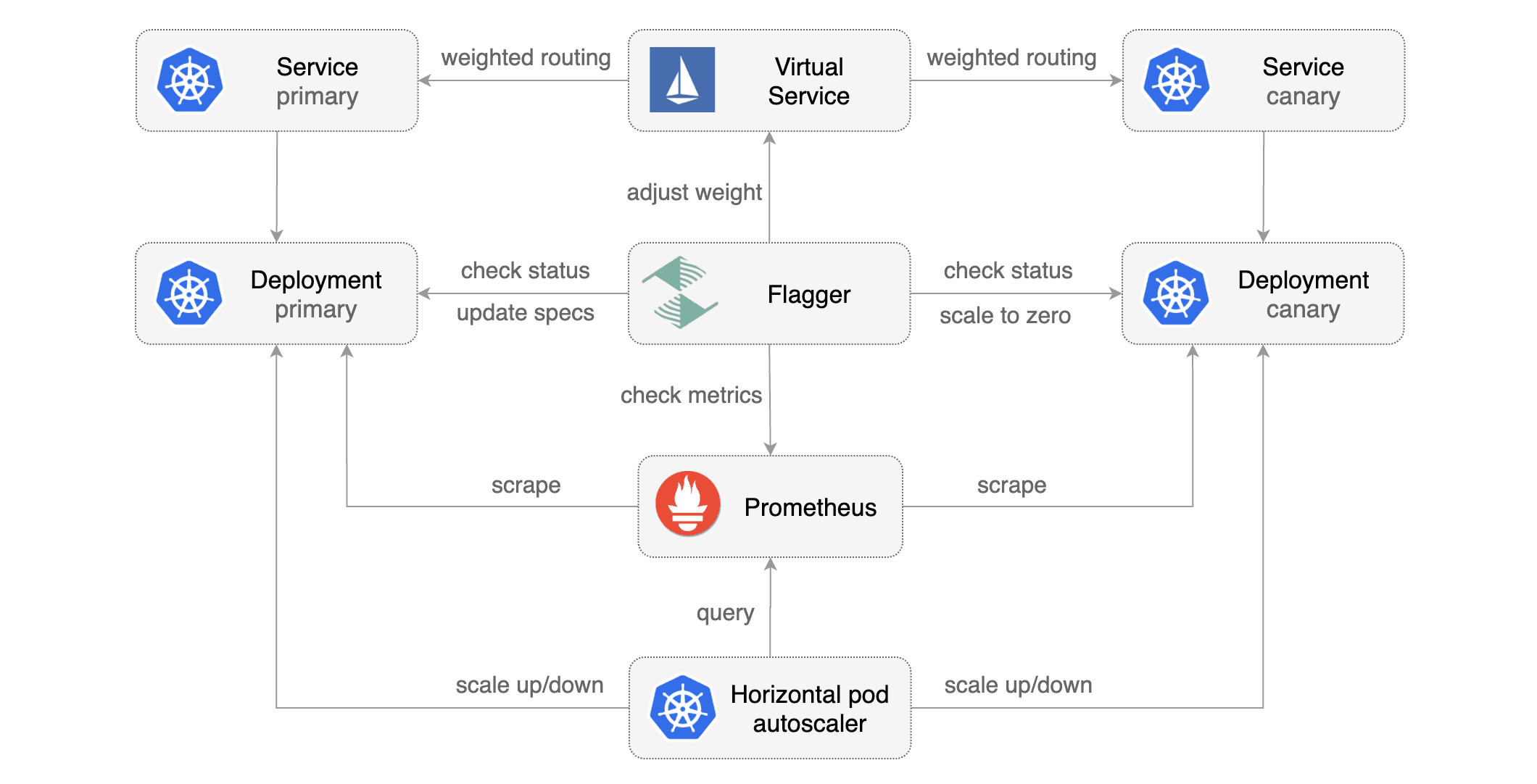
Flagger takes a Kubernetes deployment and optionally a horizontal pod autoscaler (HPA) and creates a series of objects (Kubernetes deployments, ClusterIP services and Istio virtual services) to drive the canary analysis and promotion.
Canary Custom Resource
For a deployment named podinfo, a canary promotion can be defined using Flagger's custom resource:
apiVersion: flagger.app/v1alpha2
kind: Canary
metadata:
  name: podinfo
  namespace: test
spec:
  # deployment reference
  targetRef:
    apiVersion: apps/v1
    kind: Deployment
    name: podinfo
  # the maximum time in seconds for the canary deployment
  # to make progress before it is rollback (default 600s)
  progressDeadlineSeconds: 60
  # HPA reference (optional)
  autoscalerRef:
    apiVersion: autoscaling/v2beta1
    kind: HorizontalPodAutoscaler
    name: podinfo
  service:
    # container port
    port: 9898
    # Istio gateways (optional)
    gateways:
    - public-gateway.istio-system.svc.cluster.local
    # Istio virtual service host names (optional)
    hosts:
    - app.iowa.weavedx.com
  canaryAnalysis:
    # max number of failed metric checks before rollback
    threshold: 10
    # max traffic percentage routed to canary
    # percentage (0-100)
    maxWeight: 50
    # canary increment step
    # percentage (0-100)
    stepWeight: 5
    # Istio Prometheus checks
    metrics:
    - name: istio_requests_total
      # minimum req success rate (non 5xx responses)
      # percentage (0-100)
      threshold: 99
      interval: 1m
    - name: istio_request_duration_seconds_bucket
      # maximum req duration P99
      # milliseconds
      threshold: 500
      interval: 30s
    # external checks (optional)
    webhooks:
      - name: integration-tests
        url: http://podinfo.test:9898/echo
        timeout: 1m
        metadata:
          test: "all"
          token: "16688eb5e9f289f1991c"
Canary Deployment
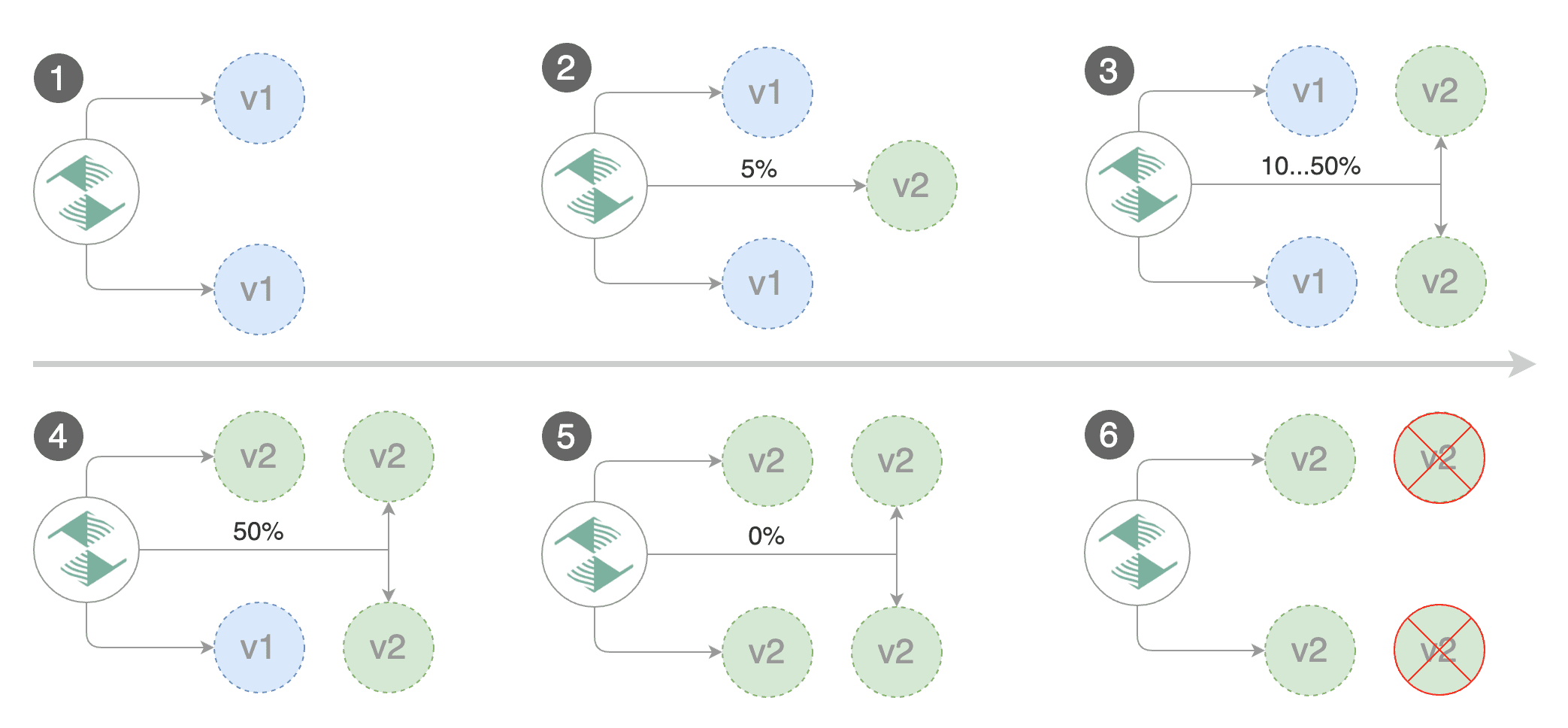
Gated canary promotion stages:
- scan for canary deployments
- creates the primary deployment if needed
- check Istio virtual service routes are mapped to primary and canary ClusterIP services
- check primary and canary deployments status
- halt advancement if a rolling update is underway
- halt advancement if pods are unhealthy
- increase canary traffic weight percentage from 0% to 5% (step weight)
- check canary HTTP request success rate and latency
- halt advancement if any metric is under the specified threshold
- increment the failed checks counter
- check if the number of failed checks reached the threshold
- route all traffic to primary
- scale to zero the canary deployment and mark it as failed
- wait for the canary deployment to be updated (revision bump) and start over
- increase canary traffic weight by 5% (step weight) till it reaches 50% (max weight)
- halt advancement while canary request success rate is under the threshold
- halt advancement while canary request duration P99 is over the threshold
- halt advancement if the primary or canary deployment becomes unhealthy
- halt advancement while canary deployment is being scaled up/down by HPA
- promote canary to primary
- copy canary deployment spec template over primary
- wait for primary rolling update to finish
- halt advancement if pods are unhealthy
- route all traffic to primary
- scale to zero the canary deployment
- mark rollout as finished
- wait for the canary deployment to be updated (revision bump) and start over
You can change the canary analysis max weight and the step weight percentage in the Flagger's custom resource.
Canary Analysis
The canary analysis runs periodically until it reaches the maximum traffic weight or the failed checks threshold.
By default the analysis interval is set to one minute and can be configured with the controlLoopInterval command flag.
Spec:
  canaryAnalysis:
    # max number of failed metric checks before rollback
    threshold: 10
    # max traffic percentage routed to canary
    # percentage (0-100)
    maxWeight: 50
    # canary increment step
    # percentage (0-100)
    stepWeight: 5
You can determine the minimum time that it takes to validate and promote a canary deployment using this formula:
controlLoopInterval * (maxWeight / stepWeight)
And the time it takes for a canary to be rollback:
controlLoopInterval * threshold
HTTP Metrics
The canary analysis is using the following Prometheus queries:
HTTP requests success rate percentage
Spec:
  canaryAnalysis:
    metrics:
    - name: istio_requests_total
      # minimum req success rate (non 5xx responses)
      # percentage (0-100)
      threshold: 99
      interval: 1m
Query:
sum(
    rate(
        istio_requests_total{
          reporter="destination",
          destination_workload_namespace=~"$namespace",
          destination_workload=~"$workload",
          response_code!~"5.*"
        }[$interval]
    )
)
/
sum(
    rate(
        istio_requests_total{
          reporter="destination",
          destination_workload_namespace=~"$namespace",
          destination_workload=~"$workload"
        }[$interval]
    )
)
HTTP requests milliseconds duration P99
Spec:
  canaryAnalysis:
    metrics:
    - name: istio_request_duration_seconds_bucket
      # maximum req duration P99
      # milliseconds
      threshold: 500
      interval: 1m
Query:
histogram_quantile(0.99,
  sum(
    irate(
      istio_request_duration_seconds_bucket{
        reporter="destination",
        destination_workload=~"$workload",
        destination_workload_namespace=~"$namespace"
      }[$interval]
    )
  ) by (le)
)
Note that the metric interval should be lower or equal to the control loop interval.
Webhooks
The canary analysis can be extended with webhooks. Flagger would call each webhook URL and determine from the response status code (HTTP 2xx) if the canary is failing or not.
Spec:
  canaryAnalysis:
    webhooks:
      - name: integration-tests
        url: http://podinfo.test:9898/echo
        timeout: 1m
        metadata:
          test: "all"
          token: "16688eb5e9f289f1991c"
      - name: load-tests
        url: http://podinfo.test:9898/echo
        timeout: 30s
        metadata:
          key1: "val1"
          key2: "val2"
Note that the sum of all webhooks timeouts should be lower than the control loop interval.
Webhook payload (HTTP POST):
{
    "name": "podinfo",
    "namespace": "test",
    "metadata": {
        "test":  "all",
        "token":  "16688eb5e9f289f1991c"
    }
}
Response status codes:
- 200-202 - advance canary by increasing the traffic weight
- timeout or non-2xx - halt advancement and increment failed checks
On a non-2xx response Flagger will include the response body (if any) in the failed checks log and Kubernetes events.