
flagger


Flagger is a Kubernetes operator that automates the promotion of canary deployments using Istio routing for traffic shifting and Prometheus metrics for canary analysis. The project is currently in experimental phase and it is expected that breaking changes to the API will be made in the upcoming releases.
Install
Before installing Flagger make sure you have Istio setup up with Prometheus enabled. If you are new to Istio you can follow my Istio service mesh walk-through.
Deploy Flagger in the istio-system namespace using Helm:
# add the Helm repository
helm repo add flagger https://stefanprodan.github.io/flagger

# install or upgrade
helm upgrade -i flagger flagger/flagger \
--namespace=istio-system \
--set metricsServer=http://prometheus.istio-system:9090 \
--set controlLoopInterval=1m
Flagger is compatible with Kubernetes >1.10.0 and Istio >1.0.0.
Usage
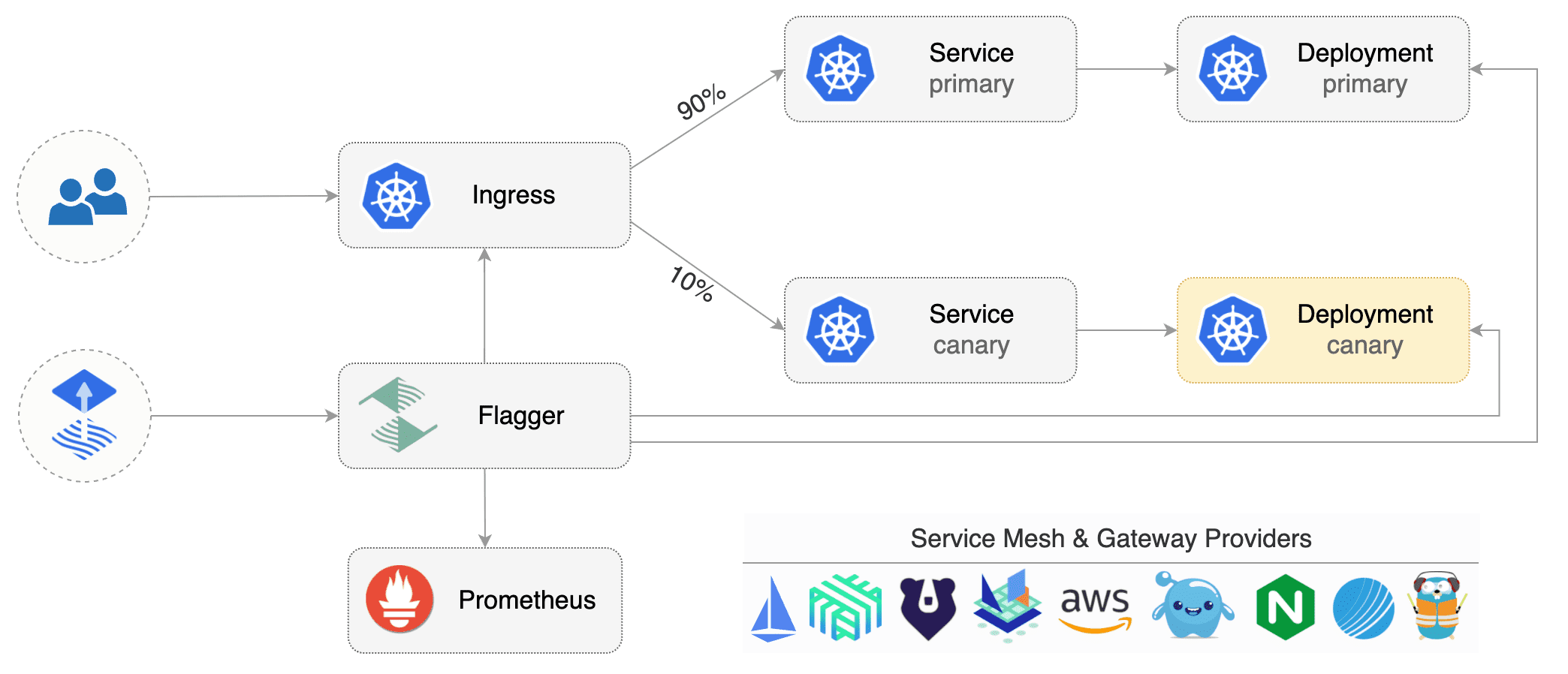
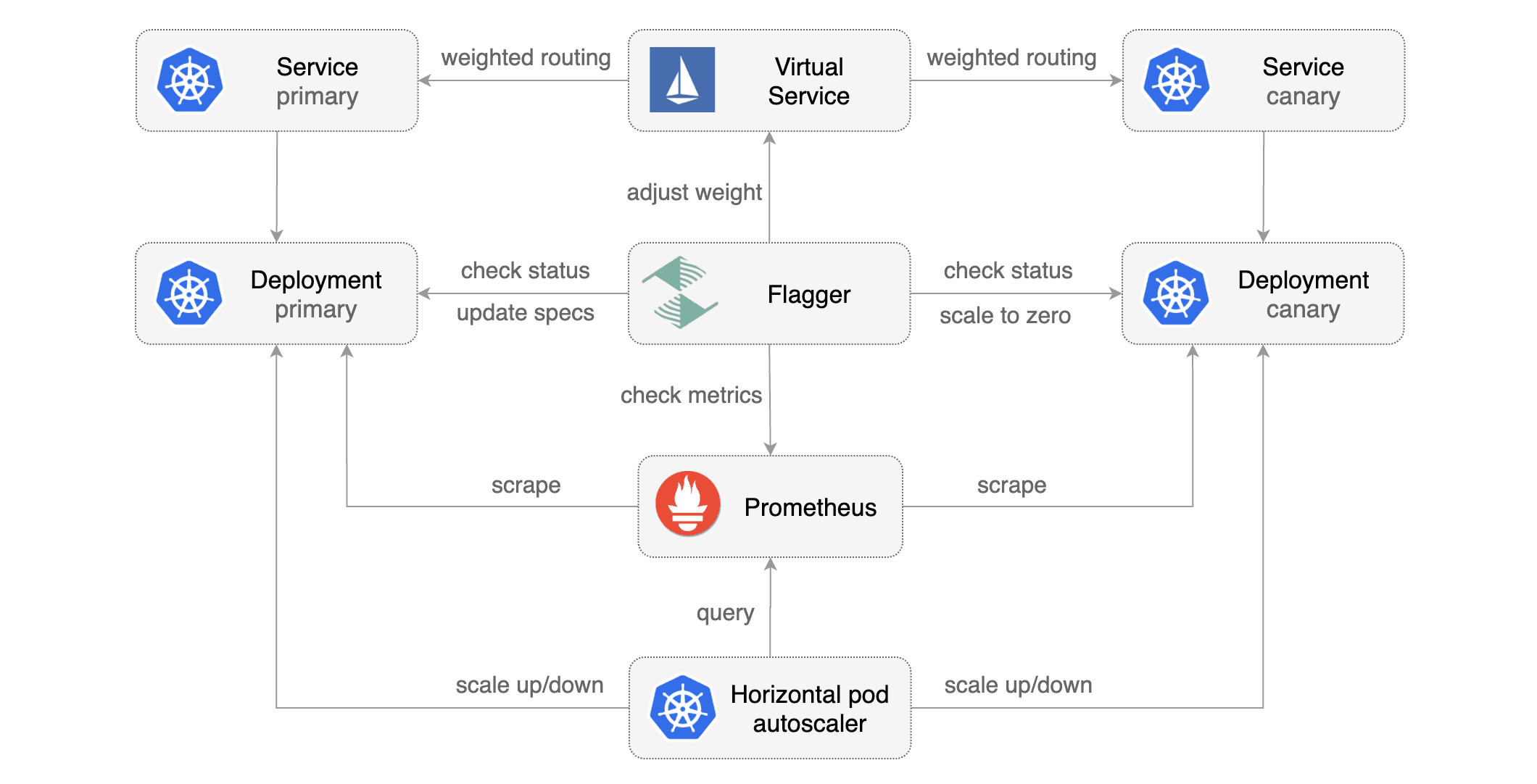
Flagger requires two Kubernetes deployments: one for the version you want to upgrade called primary and one for the canary. Each deployment must have a corresponding ClusterIP service that exposes a port named http or https. These services are used as destinations in a Istio virtual service.
Gated canary promotion stages:
- scan for canary deployments
- check Istio virtual service routes are mapped to primary and canary ClusterIP services
- check primary and canary deployments status
- halt rollout if a rolling update is underway
- halt rollout if pods are unhealthy
- increase canary traffic weight percentage from 0% to 5% (step weight)
- check canary HTTP request success rate and latency
- halt rollout if any metric is under the specified threshold
- increment the failed checks counter
- check if the number of failed checks reached the threshold
- route all traffic to primary
- scale to zero the canary deployment and mark it as failed
- wait for the canary deployment to be updated (revision bump) and start over
- increase canary traffic weight by 5% (step weight) till it reaches 50% (max weight)
- halt rollout while canary request success rate is under the threshold
- halt rollout while canary request duration P99 is over the threshold
- halt rollout if the primary or canary deployment becomes unhealthy
- halt rollout while canary deployment is being scaled up/down by HPA
- promote canary to primary
- copy canary deployment spec template over primary
- wait for primary rolling update to finish
- halt rollout if pods are unhealthy
- route all traffic to primary
- scale to zero the canary deployment
- mark rollout as finished
- wait for the canary deployment to be updated (revision bump) and start over
You can change the canary analysis max weight and the step weight percentage in the Flagger's custom resource.
Assuming the primary deployment is named podinfo and the canary one podinfo-canary, Flagger will require a virtual service configured with weight-based routing:
apiVersion: networking.istio.io/v1alpha3
kind: VirtualService
metadata:
  name: podinfo
spec:
  hosts:
  - podinfo
  http:
  - route:
    - destination:
        host: podinfo
        port:
          number: 9898
      weight: 100
    - destination:
        host: podinfo-canary
        port:
          number: 9898
      weight: 0
Primary and canary services should expose a port named http:
apiVersion: v1
kind: Service
metadata:
  name: podinfo-canary
spec:
  type: ClusterIP
  selector:
    app: podinfo-canary
  ports:
  - name: http
    port: 9898
    targetPort: 9898
Based on the two deployments, services and virtual service, a canary promotion can be defined using Flagger's custom resource:
apiVersion: flagger.app/v1beta1
kind: Canary
metadata:
  name: podinfo
  namespace: test
spec:
  targetKind: Deployment
  virtualService:
    name: podinfo
  primary:
    name: podinfo
    host: podinfo
  canary:
    name: podinfo-canary
    host: podinfo-canary
  canaryAnalysis:
    # max number of failed checks
    # before rolling back the canary
    threshold: 10
    # max traffic percentage routed to canary
    # percentage (0-100)
    maxWeight: 50
    # canary increment step
    # percentage (0-100)
    stepWeight: 5
    metrics:
    - name: istio_requests_total
      # minimum req success rate (non 5xx responses)
      # percentage (0-100)
      threshold: 99
      interval: 1m
    - name: istio_request_duration_seconds_bucket
      # maximum req duration P99
      # milliseconds
      threshold: 500
      interval: 1m
The canary analysis is using the following promql queries:
HTTP requests success rate percentage
sum(
    rate(
        istio_requests_total{
          reporter="destination",
          destination_workload_namespace=~"$namespace",
          destination_workload=~"$workload",
          response_code!~"5.*"
        }[$interval]
    )
)
/
sum(
    rate(
        istio_requests_total{
          reporter="destination",
          destination_workload_namespace=~"$namespace",
          destination_workload=~"$workload"
        }[$interval]
    )
)
HTTP requests milliseconds duration P99
histogram_quantile(0.99,
  sum(
    irate(
      istio_request_duration_seconds_bucket{
        reporter="destination",
        destination_workload=~"$workload",
        destination_workload_namespace=~"$namespace"
      }[$interval]
    )
  ) by (le)
)
Automated canary analysis, promotions and rollbacks
Create a test namespace with Istio sidecar injection enabled:
export REPO=https://raw.githubusercontent.com/stefanprodan/flagger/master

kubectl apply -f ${REPO}/artifacts/namespaces/test.yaml
Create the primary deployment, service and hpa:
kubectl apply -f ${REPO}/artifacts/workloads/primary-deployment.yaml
kubectl apply -f ${REPO}/artifacts/workloads/primary-service.yaml
kubectl apply -f ${REPO}/artifacts/workloads/primary-hpa.yaml
Create the canary deployment, service and hpa:
kubectl apply -f ${REPO}/artifacts/workloads/canary-deployment.yaml
kubectl apply -f ${REPO}/artifacts/workloads/canary-service.yaml
kubectl apply -f ${REPO}/artifacts/workloads/canary-hpa.yaml
Create a virtual service (replace the Istio gateway and the internet domain with your own):
kubectl apply -f ${REPO}/artifacts/workloads/virtual-service.yaml
Create a canary promotion custom resource:
kubectl apply -f ${REPO}/artifacts/rollouts/podinfo.yaml
Canary promotion output:
kubectl -n test describe canary/podinfo

Status:
  Canary Revision:  16271121
  Failed Checks:    6
  State:            finished
Events:
  Type     Reason  Age   From     Message
  ----     ------  ----  ----     -------
  Normal   Synced  3m    flagger  Starting canary deployment for podinfo.test
  Normal   Synced  3m    flagger  Advance podinfo.test canary weight 5
  Normal   Synced  3m    flagger  Advance podinfo.test canary weight 10
  Normal   Synced  3m    flagger  Advance podinfo.test canary weight 15
  Warning  Synced  3m    flagger  Halt podinfo.test advancement request duration 2.525s > 500ms
  Warning  Synced  3m    flagger  Halt podinfo.test advancement request duration 1.567s > 500ms
  Warning  Synced  3m    flagger  Halt podinfo.test advancement request duration 823ms > 500ms
  Normal   Synced  2m    flagger  Advance podinfo.test canary weight 20
  Normal   Synced  2m    flagger  Advance podinfo.test canary weight 25
  Normal   Synced  1m    flagger  Advance podinfo.test canary weight 30
  Warning  Synced  1m    flagger  Halt podinfo.test advancement success rate 82.33% < 99%
  Warning  Synced  1m    flagger  Halt podinfo.test advancement success rate 87.22% < 99%
  Warning  Synced  1m    flagger  Halt podinfo.test advancement success rate 94.74% < 99%
  Normal   Synced  1m    flagger  Advance podinfo.test canary weight 35
  Normal   Synced  55s   flagger  Advance podinfo.test canary weight 40
  Normal   Synced  45s   flagger  Advance podinfo.test canary weight 45
  Normal   Synced  35s   flagger  Advance podinfo.test canary weight 50
  Normal   Synced  25s   flagger  Copying podinfo-canary.test template spec to podinfo.test
  Warning  Synced  15s   flagger  Waiting for podinfo.test rollout to finish: 1 of 2 updated replicas are available
  Normal   Synced  5s    flagger  Promotion completed! Scaling down podinfo-canary.test
During the canary analysis you can generate HTTP 500 errors and high latency to test if Flagger pauses the rollout.
Create a tester pod and exec into it:
kubectl -n test run tester --image=quay.io/stefanprodan/podinfo:1.2.1 -- ./podinfo --port=9898
kubectl -n test exec -it tester-xx-xx sh
Generate HTTP 500 errors:
watch curl http://podinfo-canary:9898/status/500
Generate latency:
watch curl http://podinfo-canary:9898/delay/1
When the number of failed checks reaches the canary analysis threshold, the traffic is routed back to the primary, the canary is scaled to zero and the rollout is marked as failed.
kubectl -n test describe canary/podinfo

Status:
  Canary Revision:  16695041
  Failed Checks:    10
  State:            failed
Events:
  Type     Reason  Age   From     Message
  ----     ------  ----  ----     -------
  Normal   Synced  3m    flagger  Starting canary deployment for podinfo.test
  Normal   Synced  3m    flagger  Advance podinfo.test canary weight 5
  Normal   Synced  3m    flagger  Advance podinfo.test canary weight 10
  Normal   Synced  3m    flagger  Advance podinfo.test canary weight 15
  Normal   Synced  3m    flagger  Halt podinfo.test advancement success rate 69.17% < 99%
  Normal   Synced  2m    flagger  Halt podinfo.test advancement success rate 61.39% < 99%
  Normal   Synced  2m    flagger  Halt podinfo.test advancement success rate 55.06% < 99%
  Normal   Synced  2m    flagger  Halt podinfo.test advancement success rate 47.00% < 99%
  Normal   Synced  2m    flagger  (combined from similar events): Halt podinfo.test advancement success rate 38.08% < 99%
  Warning  Synced  1m    flagger  Rolling back podinfo-canary.test failed checks threshold reached 10
  Warning  Synced  1m    flagger  Canary failed! Scaling down podinfo-canary.test
Trigger a new canary deployment by updating the canary image:
kubectl -n test set image deployment/podinfo-canary \
podinfod=quay.io/stefanprodan/podinfo:1.2.1
Steer detects that the canary revision changed and starts a new rollout:
kubectl -n test describe canary/podinfo

Status:
  Canary Revision:  19871136
  Failed Checks:    0
  State:            finished
Events:
  Type     Reason  Age   From     Message
  ----     ------  ----  ----     -------
  Normal   Synced  3m    flagger  New revision detected podinfo-canary.test old 17211012 new 17246876
  Normal   Synced  3m    flagger  Scaling up podinfo.test
  Warning  Synced  3m    flagger  Waiting for podinfo.test rollout to finish: 0 of 1 updated replicas are available
  Normal   Synced  3m    flagger  Advance podinfo.test canary weight 5
  Normal   Synced  3m    flagger  Advance podinfo.test canary weight 10
  Normal   Synced  3m    flagger  Advance podinfo.test canary weight 15
  Normal   Synced  2m    flagger  Advance podinfo.test canary weight 20
  Normal   Synced  2m    flagger  Advance podinfo.test canary weight 25
  Normal   Synced  1m    flagger  Advance podinfo.test canary weight 30
  Normal   Synced  1m    flagger  Advance podinfo.test canary weight 35
  Normal   Synced  55s   flagger  Advance podinfo.test canary weight 40
  Normal   Synced  45s   flagger  Advance podinfo.test canary weight 45
  Normal   Synced  35s   flagger  Advance podinfo.test canary weight 50
  Normal   Synced  25s   flagger  Copying podinfo-canary.test template spec to podinfo.test
  Warning  Synced  15s   flagger  Waiting for podinfo.test rollout to finish: 1 of 2 updated replicas are available
  Normal   Synced  5s    flagger  Promotion completed! Scaling down podinfo-canary.test
Monitoring
Flagger comes with a Grafana dashboard made for canary analysis.
Install Grafana with Helm:
helm upgrade -i flagger-grafana flagger/grafana \
--namespace=istio-system \
--set url=http://prometheus.istio-system:9090
The dashboard shows the RED and USE metrics for the primary and canary workloads:
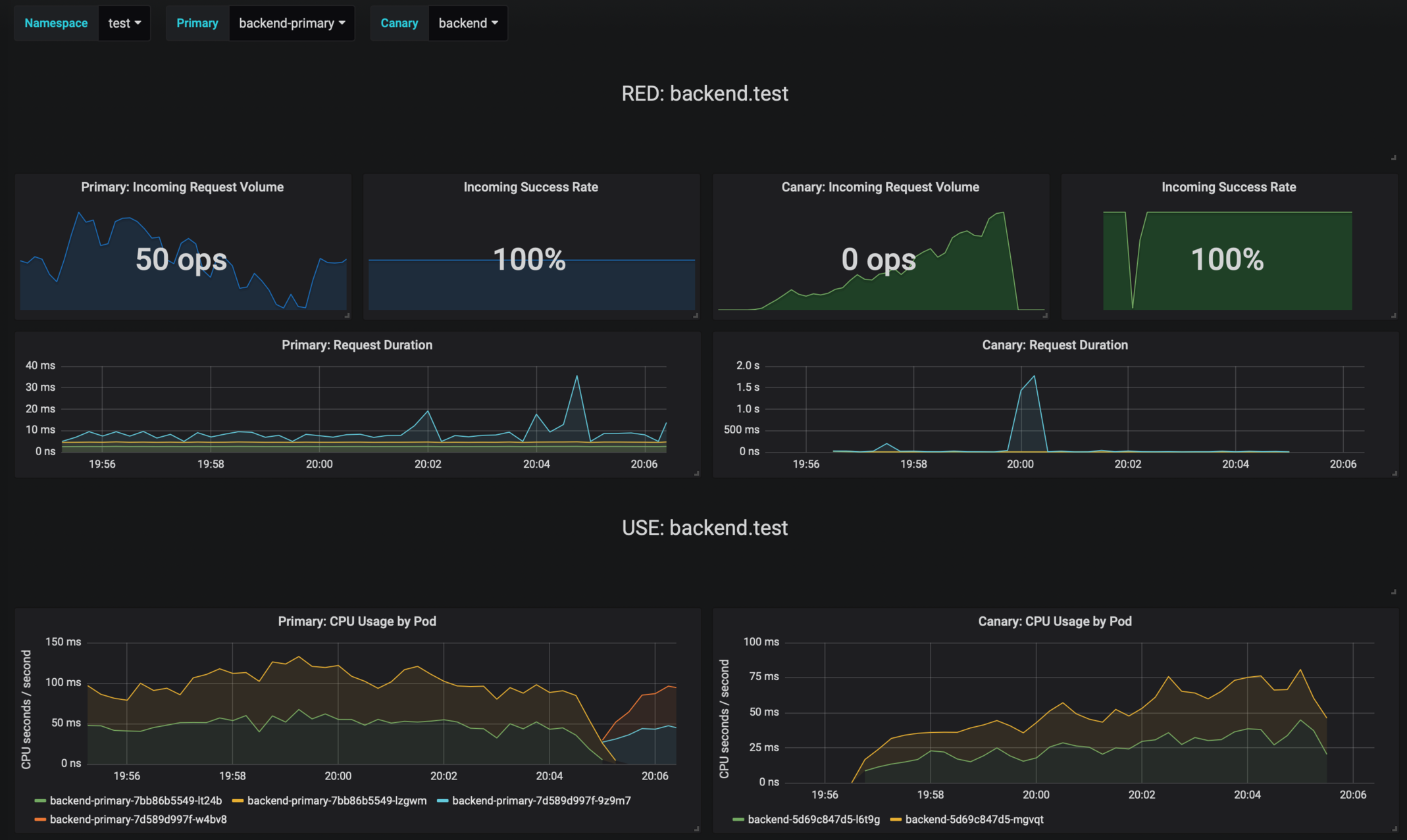
The canary errors and latency spikes have been recorded as Kubernetes events and logged by Flagger in json format:
kubectl -n istio-system logs deployment/flagger --tail=100 | jq .msg

Starting canary deployment for podinfo.test
Advance podinfo.test canary weight 5
Advance podinfo.test canary weight 10
Advance podinfo.test canary weight 15
Advance podinfo.test canary weight 20
Advance podinfo.test canary weight 25
Advance podinfo.test canary weight 30
Advance podinfo.test canary weight 35
Halt podinfo.test advancement success rate 98.69% < 99%
Advance podinfo.test canary weight 40
Halt podinfo.test advancement request duration 1.515s > 500ms
Advance podinfo.test canary weight 45
Advance podinfo.test canary weight 50
Copying podinfo-canary.test template spec to podinfo-primary.test
Scaling down podinfo-canary.test
Promotion completed! podinfo-canary.test revision 81289
Roadmap
- Extend the canary analysis and promotion to other types than Kubernetes deployments such as Flux Helm releases or OpenFaaS functions
- Extend the validation mechanism to support other metrics than HTTP success rate and latency
- Add support for comparing the canary metrics to the primary ones and do the validation based on the derivation between the two
- Alerting: Trigger Alertmanager on successful or failed promotions (Prometheus instrumentation of the canary analysis)
- Reporting: publish canary analysis results to Slack/Jira/etc
Contributing
Flagger is Apache 2.0 licensed and accepts contributions via GitHub pull requests.
When submitting bug reports please include as much details as possible:
- which Flagger version
- which Flagger CRD version
- which Kubernetes/Istio version
- what configuration (canary, virtual service and workloads definitions)
- what happened (Flagger, Istio Pilot and Proxy logs)